




Published May 18, 2026
by Stephen Brayton
• Updated June 07, 2026
Rethinking Asset Hierarchy in Maintenance: Beyond the Traditional Family Tree
 Rethinking Asset Hierarchy in Maintenance
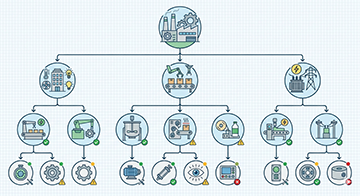
Rethinking asset hierarchy in maintenance starts with moving beyond the familiar "family tree" concept. While that structure provides value, it limits how teams visualize relationships between systems and components. A broader perspective reveals new ways to manage assets, reduce downtime, and improve decision-making. A CMMS plays a central role by connecting these models with real-time maintenance data.
What Is Asset Hierarchy in Maintenance?
Asset hierarchy organizes equipment based on relationships, function, location, or importance within a facility. Traditional models resemble a family structure, where parent assets contain children and even lower-level descendants. This layout helps maintenance teams understand how systems connect and where each component fits.
A CMMS strengthens this structure by storing each asset within a defined hierarchy. Teams gain access to maintenance history, associated parts, and work orders tied to specific equipment levels. Instead of relying on memory or spreadsheets, technicians access accurate data tied to the exact asset in question.
Yet, the traditional hierarchy only tells part of the story. Maintenance teams often need different perspectives depending on the task. Viewing assets through alternative models creates deeper insight and improves execution.
Why the Traditional "Family Tree" Model Falls Short
The family hierarchy works well for basic organization, but it does not always reflect how equipment behaves in real conditions. Systems interact in ways that a simple parent-child structure cannot fully capture.
For example, a compressor may support multiple production lines. In a strict hierarchy, that compressor sits under one system, yet its failure affects several areas. A CMMS can link that asset across multiple workflows, but a limited mindset may prevent teams from using that capability.
Maintenance teams also face challenges when diagnosing failures. A component might fail due to conditions outside its direct "family." Without broader context, technicians may treat symptoms instead of root causes.
Expanding the concept of hierarchy introduces new ways to view assets and solve problems more effectively.
Maintenance software that delivers real value
MAPCON helps maintenance teams stay ahead of work orders, support better decisions, and reduce downtime.
The "Google Maps" Model: Zooming Into Maintenance Detail
From Facility View to Component Precision
The "Google Maps" model treats asset hierarchy like a navigation system. Teams start with a wide view of the facility and zoom into specific systems, then drill down to individual components.
A food processing plant offers a clear example. At the highest level sits the entire facility. Zooming in reveals production areas such as mixing, baking, and packaging. Each area contains systems like conveyors, ovens, and cooling units. A deeper level shows motors, belts, and sensors.
This layered perspective helps maintenance teams shift quickly between big-picture planning and detailed execution.
How a CMMS Supports This Model
A CMMS allows users to navigate assets in the same way. Supervisors can review plant-wide maintenance trends, then drill into a single motor's repair history within seconds.
This approach improves planning accuracy. Instead of assigning broad work orders, teams target specific components. Inventory also benefits, since parts link directly to the correct level of equipment.
Downtime decreases because technicians spend less time searching for information and more time performing repairs.
The "Human Body" Model: Understanding System Interdependence
Systems, Organs, and Components
The human body provides another useful analogy. Each system depends on others to function properly. A problem in one area often affects another.
In a hospital environment, imaging equipment relies on electrical systems, cooling units, and software interfaces. A failure in any of these areas can disrupt operations.
Breaking this into levels:
- System: Imaging department
- Organ: MRI machine
- Tissue: Cooling system
- Cell: Pump or valve
This model highlights interdependence rather than simple hierarchy.
CMMS Benefits in Interconnected Systems
A CMMS tracks these relationships by linking assets across categories. When a technician logs an issue with a cooling pump, the system can show related equipment affected by that component.
Maintenance teams gain a clearer understanding of cause and effect. Instead of fixing isolated problems, they address connected risks.
This approach also improves preventive maintenance. Schedules can reflect how one component influences another, reducing unexpected failures across the system.
Maintenance software that delivers real value
MAPCON helps maintenance teams stay ahead of work orders, support better decisions, and reduce downtime.
The "Failure Path" Model: Tracing Cause and Effect
Following the Chain of Failure
The failure path model focuses on how breakdowns move through a system. Instead of asking "Where does this asset belong?" the question becomes "What does this asset impact?"
In a mining operation, a conveyor belt motor failure may halt material transport. That stoppage affects crushers, screening equipment, and loading operations downstream.
Mapping this path reveals the true impact of each asset.
Using a CMMS for Failure Analysis
A CMMS captures work order history, downtime events, and repair details. By analyzing this data, teams can identify patterns in failure paths.
Supervisors can prioritize maintenance based on impact rather than location alone. High-impact components receive more attention, even if they sit low in a traditional hierarchy.
This method reduces production losses and improves resource allocation. Maintenance efforts align with operational priorities instead of static structures.
Industry Applications of Alternative Hierarchy Models
Oil and Gas Operations
In pipeline systems, assets stretch across large distances and connect multiple facilities. A location-based hierarchy alone does not capture the full picture.
Using the "Google Maps" model, teams can zoom from regional networks down to specific valves. A CMMS provides real-time data for each level, helping crews respond quickly to leaks or pressure changes.
Airports and Transportation Hubs
Airports rely on interconnected systems such as baggage handling, security screening, and HVAC. The "human body" model fits well here, as each system supports overall operations.
A CMMS links these systems and tracks dependencies. When a conveyor issue arises in baggage handling, technicians can assess related systems before delays escalate.
Data Centers
Data centers require constant uptime. Cooling systems, power supplies, and server racks operate together in tight coordination.
The failure path model proves valuable in this environment. A single cooling unit failure can lead to overheating and server shutdowns.
A CMMS records these relationships and helps teams predict which components carry the highest risk.
 Inventory and Work Order Advantages Across Models
Alternative hierarchy models improve more than asset visibility. They also enhance inventory management and work order accuracy.
When each component sits in the correct context, parts lists align with actual needs. A CMMS links bills of materials directly to assets, reducing guesswork.
Work orders become more precise. Instead of assigning tasks to broad systems, teams focus on specific components. This level of detail reduces labor time and improves repair quality.
Technicians arrive prepared with the right tools and parts, which shortens repair cycles and limits repeat work.
Training and Knowledge Retention
Maintenance departments face ongoing challenges with workforce turnover. New technicians often struggle to understand complex systems.
Alternative hierarchy models provide intuitive ways to learn equipment relationships. A CMMS reinforces this learning by offering visual structures and detailed asset records.
Training becomes more efficient because information remains consistent and accessible. Teams spend less time searching for answers and more time applying knowledge.
Using Multiple Models Together
No single model fits every situation. The most effective maintenance programs combine several approaches.
A facility might use:
- The family tree for general structure
- The Google Maps model for navigation
- The human body model for system relationships
- The failure path model for risk analysis
A CMMS supports all these views by storing data in a flexible format. Users can access the same asset through different lenses depending on the task.
This flexibility leads to better decisions and more efficient maintenance practices.
A New Perspective on Maintenance Strategy
Asset Hierarchy as a Living System in CMMS
Asset hierarchy should not remain static. Equipment changes, processes evolve, and maintenance demands shift over time. Viewing hierarchy as a living system opens the door to continuous improvement.
A CMMS provides the structure and data needed to support that evolution. When teams adopt new ways of thinking about assets, they gain deeper insight into operations and uncover opportunities that traditional models often miss.
FAQs
What is asset hierarchy in a CMMS?
It organizes equipment based on relationships, making it easier to track maintenance, history, and parts.
Why move beyond the traditional asset hierarchy model?
Alternative models reveal system interactions and failure impacts that a simple structure may miss.
How does a CMMS improve asset tracking?
It stores detailed asset data, links work orders, and provides quick access to maintenance history.
Can MAPCON CMMS support multiple hierarchy models?
Yes, it allows flexible asset structures and detailed tracking across different maintenance views.
What industries benefit most from advanced asset hierarchy?
Industries with complex systems like manufacturing, healthcare, energy, and data centers see strong results.
How does asset hierarchy reduce downtime?
It helps teams identify critical components quickly and perform targeted maintenance before failures occur.
MAPCON | 800-922-4336
Try Our CMMS Software Today!
MAPCON CMMS software empowers you to plan and execute PM tasks flawlessly, thanks to its wealth of features and customizable options. Want to see it for yourself? Click the button below to get your FREE 30-day trial of MAPCON!