




Published May 06, 2026
by Stephen Brayton
• Updated June 07, 2026
The Maintenance Productivity Paradox: Navigating the Fine Line of Efficiency
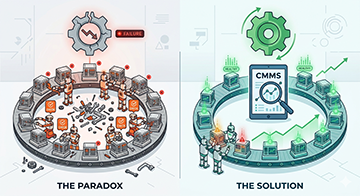 Productivity traditionally measures the output of a system against its inputs, yet maintenance departments often fall into a trap of "busy-ness" rather than "effectiveness." If a team completes fifty work orders but the plant still experiences a major breakdown, those fifty tasks yielded zero true value. This guide examines how to maximize business productivity by avoiding the hidden drains of over-scheduling and technical debt.
Defining the Productivity Paradox in Modern Maintenance
In most industrial sectors, managers equate a high volume of completed work orders with a successful operation. This creates a dangerous paradox where the pursuit of a 100% completion rate on preventive maintenance (PM) actually triggers more equipment failures. Intrusive maintenance—tasks requiring the disassembly of machines—introduces risks like fastener fatigue, seal damage, or human error during reassembly. When a crew performs these tasks too frequently, they decrease the Mean Time Between Failures (MTBF) while claiming "high productivity."
True productivity requires a shift from quantity to quality. Instead of asking how many jobs a technician finished today, leadership must ask if those jobs actually extended the life of the asset. Manufacturing plants, hospitals, and fleet operations all suffer when "checking the box" replaces critical thinking. A CMMS helps solve this by tracking the relationship between PM frequency and actual breakdown occurrences, showing exactly where a team wastes effort on healthy machines.
Identifying the Hidden Drains on Asset Reliability
Low productivity often stems from "silent killers" like unplanned downtime, but even "planned" work can drain a company's resources if it lacks purpose. For example, a facility maintenance team might spend hours each month greasing bearings that only require lubrication every quarter. This over-servicing wastes expensive synthetic grease, occupies a technician who could address a failing motor elsewhere, and risks "over-greasing" which blows out seals.
Unplanned downtime remains the most obvious obstacle to a productive shift. When a critical conveyor or a primary server goes down, the entire value chain grinds to a halt. In the hospitality industry, a broken HVAC unit doesn't just represent a repair cost; it represents a lost room, a refund, and a negative review. These "firefighting" moments represent the ultimate failure of productivity because they force the team into a reactive state where they cannot plan, delegate, or organize.
Maintenance software that delivers real value
MAPCON helps maintenance teams stay ahead of work orders, support better decisions, and reduce downtime.
Utilizing the P-F Interval to Drive Smarter Schedules
To break the cycle of over-maintenance, savvy managers look at the P-F Interval. The "P" represents the point where a potential failure is first detectable, and the "F" represents the point of functional failure. Traditional productivity suggests we should fix everything immediately on a rigid calendar. However, if a CMMS indicates that a specific vibration in a pump (the "P") takes six months to lead to a total breakdown (the "F"), performing a weekly inspection is an enormous waste of labor.
By using a CMMS to log sensor data and inspection notes, a department can "stretch" its intervals safely. This allows the team to focus on assets that actually show signs of distress. Instead of a technician wandering the plant to check every motor, the CMMS generates a targeted list of only the equipment nearing its specific P-F threshold. This data-driven approach ensures every hour of labor spent yields the highest possible return on asset uptime.
Refining Labor Allocation Through Better Delegation
Delegation often fails because managers lack a clear view of their team's specialized skills. Sending a general mechanic to fix a complex PLC issue results in hours of wasted troubleshooting and potential safety risks. Productivity spikes when the right person meets the right task at the right time. A CMMS stores "craft" and "skill" levels for every employee, allowing a supervisor to filter work orders by expertise instantly.
Furthermore, assigning a crew via a digital system eliminates the "morning huddle" lag. Technicians don't need to wait for a paper handout or a verbal briefing. They log into a mobile app, see their prioritized tasks for the day, and access the exact parts and tools required before they ever leave the shop. This reduces "travel time," which remains one of the largest unmeasured drains on industrial productivity.
Enhancing Environmental Factors and Safety Compliance
Productivity relies heavily on the environment where the work occurs. Dark, cramped, or dangerously hot spaces naturally slow down even the most skilled workers. While a maintenance manager cannot always move a stationary asset, they can use a CMMS to improve the "information environment." Attaching safety protocols, lockout-tagout (LOTO) procedures, and digital manuals to a work order ensures the technician doesn't have to leave the job site to find answers.
Safety and productivity are not opposing forces. Cutting corners to finish a job faster creates a "technical debt" that eventually comes due in the form of an accident or a rework. A CMMS forces a standardized approach through mandatory checklists. By requiring a technician to sign off on safety steps before closing a task, the organization builds a culture of "doing it right the first time," which is the only sustainable way to keep production numbers high.
Scaling Operations for Future Market Demands
As a business grows, its maintenance needs don't just increase—they become more complex. A small shop might manage with spreadsheets, but a multi-site operation will drown in them. Spreadsheets lack the ability to trigger automatic alerts, track inventory across different locations, or provide real-time cost reports. They are static documents in a dynamic world.
Upgrading to a CMMS provides the scalability necessary to handle more assets without necessarily hiring more administrative staff. The software automates the tedious parts of the job, such as reordering parts when inventory hits a minimum threshold or generating monthly compliance reports. This automation frees up the leadership team to focus on high-level strategy and continuous improvement rather than manual data entry.
Accelerate your maintenance results
Pick the next step that fits you best: start your free trial or see MAPCON live with our team.
Shifting Toward a Data-First Maintenance Culture
Building a productive maintenance department requires more than just new tools; it requires a mindset shift. Every repair provides data, and that data must find a home in a centralized system. When a technician notes that a specific brand of belt lasts 20% longer than another, that information should influence future purchasing decisions. A CMMS turns anecdotal evidence into actionable business intelligence.
Efficiency improves when the team stops guessing. Instead of wondering if a machine is "reliable," the manager looks at the CMMS dashboard to see the exact cost-to-maintain versus the asset's replacement value. This clarity allows for better budgeting and capital expenditure planning. When the maintenance team can prove their value through hard data, they stop being viewed as a "cost center" and start being seen as a "profit protector."
Stop Managing Failures and Start Managing Health
True business productivity arrives when a maintenance department stops measuring its success by how quickly it repairs broken machines and starts measuring how long those machines stay healthy. Every repair, no matter how efficient, represents a failure of the preventive system. To move beyond the paradox, leadership must treat asset health as a holistic goal. This involves a shift from time-based maintenance—doing things because the calendar says so—to condition-based maintenance—doing things because the asset actually needs them.
When a facility utilizes a CMMS, it gains the ability to see the "big picture" across multiple sites or departments. This high-level view reveals patterns that stay hidden in a world of paper and spreadsheets. Perhaps a specific motor brand fails 15% faster in high-humidity environments, or a certain technician consistently finishes pump repairs with fewer follow-up calls. These insights allow for a "precision maintenance" approach. By applying effort exactly where it yields the most uptime, the company avoids the trap of being "busy" without being "effective."
Ultimately, the goal is to create a self-sustaining cycle of reliability. A CMMS acts as the central nervous system for this cycle, collecting data, notifying the right people, and providing the documentation needed to prove results. When the maintenance team stops chasing emergencies and starts managing long-term asset health, the entire organization experiences a surge in productivity. Costs go down, morale goes up, and the company finally breaks free from the diminishing returns of the maintenance paradox.
FAQs
What is the maintenance productivity paradox?
The paradox occurs when performing too much preventive maintenance actually increases equipment failure rates due to intrusive errors and wasted labor.
How does a CMMS reduce unplanned downtime?
By tracking equipment history and sensor data, a CMMS from MAPCON helps teams identify early warning signs and perform repairs before a total breakdown occurs.
Can a mobile app really help maintenance technicians?
A mobile CMMS app allows technicians to access manuals, parts lists, and safety checklists at the asset, reducing unnecessary travel time back to the office.
What is the P-F Interval in maintenance?
The P-F Interval is the time between the first detection of a potential failure and the moment the machine stops working, which helps determine the best time to perform repairs.
How do checklists improve workplace safety?
Checklists inside a CMMS ensure that technicians follow every safety protocol, such as lockout-tagout, before they can physically start or finish a high-risk job.
Is it difficult to transition from spreadsheets to a CMMS?
While it requires an initial data upload, MAPCON offers training and support to ensure the transition leads to immediate gains in organization and reporting accuracy.
MAPCON | 800-922-4336
Try Our CMMS Software Today!
MAPCON CMMS software empowers you to plan and execute PM tasks flawlessly, thanks to its wealth of features and customizable options. Want to see it for yourself? Click the button below to get your FREE 30-day trial of MAPCON!