




Published June 29, 2026
by Stephen Brayton
• Updated June 29, 2026
Maintenance as a Competitive Weapon: How Top Manufacturers Use CMMS to Outperform Rivals
The Hidden Edge Most Manufacturers Overlook
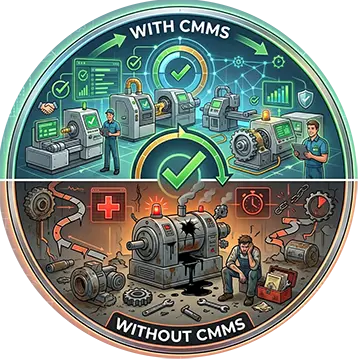 In a market where production speed, quality, and delivery reliability separate winners from also-rans, top manufacturers have discovered a powerful truth: maintenance isn't a cost center—it's a competitive weapon. Companies that treat their maintenance operations strategically achieve 95%+ equipment uptime, slash repair times, and extend asset lifespans well beyond industry averages. The tool driving this transformation is a Computerized Maintenance Management System, better known as a CMMS. Can CMMS help reduce equipment downtime? The evidence from the factory floor says yes—decisively.
Why Downtime Is More Expensive Than Most Companies Realize
From Reliable: The cost of unplanned downtime in manufacturing now averages $260,000 per hour across all sectors, according to Aberdeen Research. For an automotive assembly plant, a single unplanned line stoppage can cost tens of thousands of dollars per hour. For a food and beverage processor, an unexpected packaging line failure doesn't just halt production—it risks spoilage, missed shipments, and customer penalties.
Most operations managers focus on the visible cost: idle workers, missed output targets, and emergency repair bills. The hidden costs cut deeper. Rush orders for replacement parts arrive at premium prices. Technicians pulled from scheduled tasks leave other equipment under-maintained. Customers who experience delivery failures quietly shift their business elsewhere. The damage compounds with every unplanned failure.
Reactive maintenance—fixing things after they break—keeps manufacturers permanently on the back foot. The companies pulling ahead on the competitive landscape have moved from reactive to planned, and the vehicle for that shift is a CMMS.
What a CMMS Actually Does
A CMMS centralizes every element of a maintenance operation into one system. Work orders, asset histories, parts inventories, technician schedules, compliance records, and maintenance logs all live in a single platform accessible in real time. Rather than relying on tribal knowledge, spreadsheets, and paper logs, maintenance teams gain a complete picture of every asset in their facility.
The practical impact shows up fast. When a technician receives an automated work order for a scheduled service on a bottling line filler, they arrive with the correct parts in hand, the maintenance history on their tablet, and a clear checklist to follow. The job gets done right, gets documented immediately, and feeds back into the system so the next service interval adjusts accordingly.
Beyond individual jobs, a CMMS captures historical data that management can analyze at the fleet level. Which assets fail most often? Which failure modes cost the most to repair? Where do technicians spend the majority of their labor hours? That data turns maintenance from guesswork into an informed discipline.
Maintenance software that delivers real value
MAPCON helps maintenance teams stay ahead of work orders, support better decisions, and reduce downtime.
Real-Time Performance Tracking Changes the Game
Visibility Across the Entire Operation
One of the most powerful CMMS benefits is real-time visibility into equipment condition and maintenance status. Plant managers no longer wait for end-of-shift reports to learn that a critical compressor has been running hot all day.
For example, a specialty chemical manufacturer used its CMMS to analyze the history of gauge and meter readings across its reactor vessels and heat exchangers. The result was a measurable reduction in unplanned shutdowns and a documented increase in overall equipment effectiveness (OEE). The maintenance team shifted from spending the majority of their labor hours reacting to emergencies to executing planned work—a reversal that freed up capacity and reduced overtime costs simultaneously.
Automated Work Orders Remove the Human Delay
In traditional maintenance operations, the gap between identifying a problem and getting a technician on site can stretch hours or days. A supervisor notices an issue, calls the maintenance department, a work order gets written up manually, and a technician eventually receives the assignment. Every step in that chain introduces delay.
Automated work orders eliminate the chain. A CMMS triggers work orders based on time intervals, meter readings, or condition thresholds—with no human required to initiate the process. A fleet maintenance operation managing hundreds of heavy trucks can configure its CMMS to generate a work order for brake inspection at a specific mileage milestone, route it to the next available technician with the relevant certification, and attach the manufacturer's service documentation—all automatically.
That speed matters. The faster a maintenance team responds to a developing issue, the less damage occurs, the shorter the repair, and the lower the cost.
Maintenance Schedules Built on Data, Not Habit
Breaking the "We've Always Done It This Way" Cycle
Many manufacturers still run maintenance schedules inherited from the plant's original equipment installation—intervals set by a vendor's general recommendation decades ago, never updated to reflect actual operating conditions. A CMMS breaks that cycle by collecting real usage and failure data that makes schedules more accurate over time.
A paper mill running two shifts per day in a humid Southern climate has fundamentally different maintenance needs than the same equipment running one shift per day in an air-conditioned Midwest facility. A CMMS captures the operating hours, environmental readings, and failure history specific to each asset and helps maintenance managers calibrate intervals to actual conditions rather than generic defaults.
The payoff compounds. Shorter intervals mean unnecessary maintenance costs—labor, parts, and downtime for work the asset didn't actually need. Longer intervals on assets that genuinely require them reduce unnecessary touches. A CMMS finds the right balance by learning from historical data, and that balance translates directly into lower maintenance costs and higher uptime.
Extending Asset Lifespans Beyond Manufacturer Estimates
Industrial assets maintained on optimized schedules consistently outlast assets maintained reactively. A well-maintained CNC machining center can run 20 years or longer. The same machine subjected to repeated unplanned failures, emergency repairs, and deferred maintenance may reach end of life in half that time.
CMMS-driven maintenance programs document every service event, part replacement, and repair for each asset. That complete history gives maintenance engineers the data to make evidence-based decisions about rebuilds versus replacements—decisions that can save hundreds of thousands of dollars on major capital assets.
The Competitive Arithmetic of CMMS Adoption
Uptime as a Customer Promise
Manufacturers who achieve and sustain 95%+ equipment uptime can make delivery commitments their competitors cannot. For a contract electronics manufacturer competing for a program with tight just-in-time delivery windows, demonstrated uptime performance is a differentiator in the sales process. For a food producer supplying a major retailer, consistent delivery reliability earns preferred supplier status and better shelf placement.
A CMMS makes uptime measurable and reportable. Maintenance managers can generate uptime reports by asset, by line, or by plant—and share those numbers in customer conversations, Request for Proposals (RFP) responses, and contract negotiations. What was once an invisible internal metric becomes a customer-facing competitive asset.
Speed of Repair When Failures Do Occur
Even the best-maintained facilities experience failures. The competitive difference lies in how fast operations recover. CMMS-driven maintenance departments resolve unplanned failures faster because the system provides immediate access to asset history, parts availability, and technician qualifications.
When a conveyor drive motor fails at an automotive stamping plant, the maintenance technician assigned to the work order can pull up the motor's complete service history, confirm that a replacement unit sits in the storeroom, and check the wiring diagrams—all from a mobile device before leaving the tool crib. That information removes the diagnostic fumbling that adds hours to repairs handled by teams working from memory and paper files.
Parts Inventory That Doesn't Drain the Budget
 Maintenance parts inventory ties up significant working capital in most manufacturing facilities. Too little stock means waiting days for a critical part during an unplanned failure. Too much stock means carrying costs, obsolescence risk, and warehouse space consumed by parts that never turn.
A CMMS tracks parts consumption against work order history and flags minimum stock levels when replenishment is needed. Over time, the system builds a clear picture of which parts move regularly and which sit idle. Purchasing teams gain the data to negotiate better pricing on high-volume items and eliminate dead stock that drains the budget. That inventory discipline contributes directly to the cost structure advantages that let high-performing manufacturers price more competitively.
Accelerate your maintenance results
Pick the next step that fits you best: start your free trial or see MAPCON live with our team.
Building a Maintenance Culture That Sustains the Advantage
Technology alone doesn't create competitive advantage—the culture and discipline to use it well does. Manufacturers who extract the most value from a CMMS treat the system as the authoritative record for everything maintenance-related. Work orders don't get closed without complete documentation. Parts usage gets logged accurately. Failure codes get recorded consistently so the data analysts can identify patterns.
That discipline requires leadership investment. Plant managers who review CMMS dashboards regularly, set performance targets for planned maintenance compliance, and recognize teams that hit uptime goals create organizations where the system actually gets used—and where the data stays clean enough to support meaningful analysis.
The manufacturers who build that culture gain a durable advantage. New equipment, faster machines, and more efficient processes are available to any competitor with the capital to purchase them. A maintenance organization that consistently achieves high uptime, low repair costs, and long asset lifespans through disciplined CMMS use takes years to build—and can't be replicated simply by writing a check.
The Strategic Case for CMMS Investment
The business case for CMMS adoption extends well beyond maintenance department efficiency. When maintenance leaders can demonstrate that their program delivers 95%+ uptime, cuts mean time to repair by measurable percentages, and extends asset lifespans, they make a strategic argument to the C-suite—not just a cost-reduction argument.
Capital allocation decisions change when leadership understands that proactive maintenance produces returns comparable to new equipment purchases, at a fraction of the cost. Customer relationship conversations shift when sales teams can point to documented reliability performance. Operational planning gets more accurate when production scheduling can rely on assets being available when the plan calls for them.
Turning Maintenance Into a Long-Term Competitive Advantage
The manufacturers who outperform their rivals over the long run don't just run leaner—they run smarter. A CMMS gives maintenance teams the tools to act on information rather than intuition, to plan rather than react, and to continuously improve rather than repeat the same costly cycles year after year. The factories that master this discipline don't just reduce downtime. They build an operational foundation that supports faster production, better quality, stronger customer relationships, and superior financial performance. Maintenance, managed strategically through a CMMS, stops being something the plant has to do—and starts being something the plant gets to do better than everyone else.
FAQs
Can a CMMS really reduce unplanned equipment downtime?
Yes — a CMMS reduces unplanned downtime by automating preventive maintenance schedules and triggering work orders before failures occur, keeping equipment running instead of waiting for reactive repairs.
How does CMMS software improve equipment uptime in manufacturing?
A CMMS tracks real-time asset performance, automates work order generation, and maintains complete service histories, giving maintenance teams the information they need to act fast and stay ahead of failures.
What is the ROI of implementing a CMMS for maintenance management?
Manufacturers who adopt a CMMS typically see measurable reductions in repair costs, overtime labor, and emergency parts purchasing — savings that compound as asset lifespans extend and unplanned failures decline.
How does MAPCON CMMS help manufacturers achieve higher equipment uptime?
MAPCON's CMMS gives maintenance teams real-time visibility into asset condition, automated preventive maintenance scheduling, and detailed work order tracking — all designed to keep production lines running at peak availability.
What data does a CMMS capture to support better maintenance decisions?
A CMMS records every work order, parts transaction, labor hour, and failure event tied to each asset, building a historical record that managers use to refine maintenance intervals and reduce repeat failures.
Can MAPCON CMMS be used to manage maintenance across multiple facilities?
Yes — MAPCON is built to support multi-site operations, giving maintenance managers a unified view of assets, work orders, and performance metrics across every facility from a single platform.
MAPCON | 800-922-4336
Try Our CMMS Software Today!
MAPCON CMMS software empowers you to plan and execute PM tasks flawlessly, thanks to its wealth of features and customizable options. Want to see it for yourself? Click the button below to get your FREE 30-day trial of MAPCON!