




Published June 15, 2026
by Stephen Brayton
• Updated June 15, 2026
When the Cloud Isn't Enough: The Case for Self-Hosted CMMS in High-Security Industries
Why Hosting Your CMMS On-Premises May Be the Smarter Move
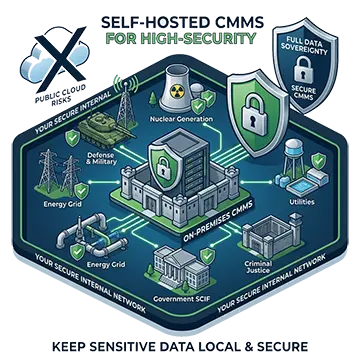 The debate between cloud-hosted and self-hosted Computerized Maintenance Management Systems (CMMS) carries real weight for industries where data security isn't a preference — it's a mandate. Cloud-hosted CMMS platforms offer undeniable advantages: lower upfront costs, automatic updates, and easy accessibility from any device. Yet for certain industries, those conveniences arrive with trade-offs that no IT policy, vendor SLA, or encryption certificate can fully offset. Self-hosting a CMMS keeps sensitive operational data exactly where it belongs — inside the organization's own walls.
What a CMMS Actually Does — and Why It Matters
Before examining where a CMMS should live, it helps to understand what it does. A CMMS centralizes maintenance operations across an entire organization. It tracks work orders, schedules preventive maintenance, manages asset lifecycles, coordinates inventory for spare parts and supplies, and produces compliance documentation — all from a single platform.
The operational benefits touch every level of a facility. Maintenance technicians receive clear, prioritized task lists. Supervisors gain real-time visibility into equipment status and labor productivity. Procurement teams track parts consumption and identify reorder triggers. Executives access maintenance cost data tied directly to assets and departments.
Work Order Management
At its core, a CMMS replaces paper logs and fragmented spreadsheets with a structured, searchable work order system. A technician submits a request, the system routes it to the right team with the right priority level, and the completed record becomes part of a permanent asset history. That history proves invaluable during audits, insurance reviews, and regulatory inspections.
Preventive Maintenance Scheduling
Rather than waiting for equipment to fail — a reactive approach that drives up repair costs and downtime — a CMMS schedules maintenance based on time intervals, meter readings, or manufacturer specifications. A municipal water treatment plant, for instance, can schedule pump inspections every 500 operating hours and receive automatic reminders before the threshold hits. Equipment stays reliable, and service life extends.
Asset and Inventory Tracking
A CMMS maintains a complete inventory of physical assets — from HVAC units and generators to vehicles and specialty tools — along with associated documentation, warranties, and maintenance histories. Spare parts inventory integrates directly, so when a work order goes out, the system confirms parts availability before the technician ever leaves the shop.
Accelerate your maintenance results
Pick the next step that fits you best: start your free trial or see MAPCON live with our team.
The Cloud vs. On-Premises Question
Cloud-hosted CMMS solutions argue, reasonably, that provider-managed infrastructure reduces the burden on internal IT teams. Automatic software updates, offsite data backup, and subscription-based pricing all lower the operational overhead of running a CMMS. For small businesses, manufacturers with standard compliance requirements, or companies without a dedicated IT department, a cloud solution often makes strong practical sense.
But the argument for cloud hosting rests on a critical assumption: that the risks of housing operational data on external servers remain acceptable. For a growing number of industries, that assumption fails.
A cloud-hosted CMMS means maintenance records, asset configurations, work order histories, and operational schedules travel across the internet and live on servers managed by a third party. The CMMS vendor controls the security architecture, determines patch timing, and shares infrastructure across multiple clients. That arrangement introduces vectors of exposure that certain regulated, security-conscious industries simply cannot accept.
Industries That Require On-Premises Control
Defense and Military Installations
Military facilities manage some of the most sensitive infrastructure on the planet. Maintenance records for weapons systems, base utilities, vehicle fleets, and communications equipment contain operationally significant data. Exposing any of that information to a shared cloud environment — even an encrypted one — creates risk that defense protocols prohibit.
The U.S. Department of Defense operates under the Cybersecurity Maturity Model Certification (CMMC) framework, which establishes strict requirements for how contractors and agencies handle Controlled Unclassified Information (CUI). A self-hosted CMMS running on an air-gapped or classified network keeps maintenance data within the facility's security perimeter and subject to direct DoD oversight. No vendor update schedule, no third-party server access, no shared infrastructure — just internal control.
Nuclear Power Generation
Nuclear facilities operate under some of the most stringent regulatory frameworks in any industry. The Nuclear Regulatory Commission (NRC) mandates rigorous documentation of maintenance activities across all safety-related systems. Every valve inspection, every calibration record, every corrective maintenance action on a reactor's safety equipment must meet NRC requirements for accuracy, retention, and access control.
A self-hosted CMMS at a nuclear facility integrates directly with plant-specific control systems and stores maintenance histories on internal servers that auditors and internal safety teams access without relying on a vendor's portal. The facility controls who sees what, retains records according to its own retention schedule, and keeps all data within a physically secured environment — not replicated across a commercial cloud provider's data centers.
Water and Wastewater Utilities
Municipal water systems sit at the intersection of public health and critical infrastructure. The Environmental Protection Agency (EPA) and state regulators require detailed records of equipment maintenance across treatment processes, pumping stations, and distribution infrastructure. More pressing: water utilities rank among the most-targeted systems in domestic cyberattack campaigns.
A cloud-hosted CMMS for a water utility creates a potential attack surface. Adversaries who gain access to maintenance schedules, equipment configurations, and chemical dosing records could, in theory, exploit that information to time disruptions or identify operational vulnerabilities. An on-premises CMMS, hosted on an isolated network without external connectivity, removes that exposure entirely. Local control means local security.
Criminal Justice and Law Enforcement
County jails, state prisons, and federal detention facilities run complex physical plants — HVAC systems, security doors, perimeter lighting, surveillance infrastructure, and backup power systems — all requiring ongoing maintenance. Maintenance records for a detention facility can reveal security system configurations, access control schedules, and equipment vulnerabilities that fall squarely into sensitive operational territory.
Law enforcement agencies also manage vehicle fleets, weapons storage, and communications equipment through facility management systems. Keeping those records on-premises, behind a law enforcement network's security architecture, limits access to credentialed personnel within the agency and keeps vendor relationships from touching operationally sensitive data.
Maintenance software that delivers real value
MAPCON helps maintenance teams stay ahead of work orders, support better decisions, and reduce downtime.
Intelligence Agencies and Secure Government Campuses
Facilities that house classified operations — whether federal intelligence agencies, secure government research campuses, or sensitive compartmented information facilities (SCIFs) — cannot use commercial cloud platforms for any system touching facility operations. A CMMS at these facilities tracks everything from electrical system maintenance to HVAC performance in spaces where environmental stability directly affects classified equipment.
Self-hosted deployment on classified or restricted networks allows these facilities to maintain operational logs without creating any external data pathway. The CMMS becomes part of the classified infrastructure itself, subject to the same access controls, audit logging, and physical security requirements as every other system in the facility.
Energy Grid and Pipeline Infrastructure
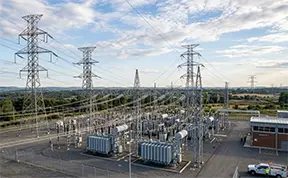 Operators of electrical transmission systems, natural gas pipelines, and petroleum infrastructure fall under the North American Electric Reliability Corporation (NERC) Critical Infrastructure Protection (CIP) standards. Those standards impose specific requirements on how operational technology systems — including maintenance management platforms — handle data, control access, and respond to security incidents.
A pipeline operator using a cloud-hosted CMMS introduces a dependency on an external system for tracking maintenance of assets that directly affect energy delivery. A self-hosted system keeps that dependency internal, meets CIP access control requirements without relying on vendor cooperation, and allows the operator to define its own incident response procedures without waiting on a third-party provider.
The Security Architecture Advantages of On-Premises CMMS
Full Data Sovereignty
On-premises deployment means the organization owns and controls every byte of maintenance data. There are no third-party backup servers, no vendor data retention policies to review, and no exposure from a vendor's other clients. If the CMMS vendor suffers a breach on its cloud infrastructure, on-premises customers remain unaffected.
Network Isolation
A self-hosted CMMS can operate entirely within an air-gapped network — one with no connection to the public internet whatsoever. Air-gapping eliminates the most common attack vectors: phishing links that phone home, external scanning tools, and remote exploitation of public-facing services. For defense and nuclear applications, this isolation isn't optional; it's the baseline.
Custom Access Controls
Internal IT teams can configure role-based access at a granular level, integrating the CMMS with existing directory services like Active Directory and applying the organization's own multi-factor authentication policies. Every login, every record change, and every report export can feed into the organization's centralized security information and event management (SIEM) system.
Compliance Documentation on Internal Terms
Regulatory audits in defense, nuclear, and utility sectors require comprehensive documentation of system access and data handling. A self-hosted CMMS produces audit logs that the organization controls and retains according to its own compliance schedule — not according to what a vendor's portal makes available or how long the vendor retains export records.
Addressing the Trade-offs Honestly
On-premises deployment carries real costs. Internal IT teams bear responsibility for server maintenance, software updates, backup management, and disaster recovery. Upfront infrastructure investment runs higher than a SaaS subscription. These realities matter.
But the relevant comparison for a defense contractor or nuclear operator isn't between self-hosting and a consumer cloud app. It's between the cost of maintaining secure internal infrastructure and the cost of a data breach, a compliance violation, or — in the most serious cases — a security incident with physical consequences. Framed that way, the economics of on-premises deployment shift considerably.
Many CMMS vendors offer on-premises licensing specifically for regulated industries, often including dedicated implementation support and the same feature depth available in their cloud products. The functionality gap between cloud and on-premises has narrowed significantly in recent years.
The Strategic Value of Control
The strongest argument for self-hosted CMMS in high-security industries isn't technical — it's strategic. Organizations in defense, energy, criminal justice, and regulated utilities don't outsource their security posture to vendors in other domains. Maintenance data management shouldn't be the exception.
A CMMS delivers enormous operational value regardless of where it runs: better asset reliability, lower unplanned downtime, tighter compliance documentation, and clearer visibility into maintenance costs. The question isn't whether to use a CMMS. For security-critical industries, the question is simply this — who controls the data it generates?
Choosing the Right Deployment Model Starts with Knowing What You're Protecting
The cloud-versus-on-premises conversation ultimately resolves around one question: what does your organization stand to lose if maintenance data lands in the wrong hands? For most industries, a well-secured cloud solution answers that question adequately. For the industries discussed here, it doesn't — and no vendor promise changes that calculus.
Security-critical organizations that invest in self-hosted CMMS infrastructure gain something that no subscription tier provides: complete, unambiguous control over the systems that keep their facilities running and their data contained. That control carries costs, and it carries responsibility. For industries where the alternative carries far greater risk, it remains the right choice.
FAQs
Can a CMMS system be self-hosted on a private network without internet access?
Yes — a self-hosted CMMS can operate on a fully air-gapped network, completely isolated from the public internet. MAPCON's on-premises CMMS is designed to support exactly this kind of closed, secure deployment.
What industries benefit most from an on-premises CMMS over a cloud solution?
Industries with strict regulatory or security requirements — such as defense contractors, nuclear facilities, water utilities, and correctional institutions — benefit most from on-premises deployment. These sectors need direct control over who accesses maintenance data and where it physically resides.
How does a self-hosted CMMS help with regulatory compliance?
A self-hosted CMMS stores audit logs, maintenance records, and asset histories entirely within the organization's own infrastructure, making it easier to meet frameworks like NERC CIP, NRC requirements, and DoD CMMC standards. The organization controls retention schedules and access permissions without depending on a third-party vendor's portal.
Is an on-premises CMMS harder to maintain than a cloud-hosted system?
On-premises deployment does require internal IT resources for server upkeep, updates, and backups, but vendors like MAPCON offer dedicated implementation support to ease that burden. For security-critical industries, that trade-off is a worthwhile exchange for full data sovereignty.
What maintenance tasks can a CMMS manage for high-security facilities?
A CMMS handles work orders, preventive maintenance scheduling, asset tracking, spare parts inventory, and compliance documentation — all from a single platform. These capabilities apply equally to military installations, energy infrastructure, and government campuses.
Why is data sovereignty important when choosing a CMMS deployment model?
Data sovereignty means the organization retains complete ownership and control of its maintenance records, with no exposure to third-party server breaches or vendor data policies. For facilities managing classified systems or critical infrastructure, that control is not optional — it is a security baseline.
MAPCON | 800-922-4336
Try Our CMMS Software Today!
MAPCON CMMS software empowers you to plan and execute PM tasks flawlessly, thanks to its wealth of features and customizable options. Want to see it for yourself? Click the button below to get your FREE 30-day trial of MAPCON!