




Published September 21, 2026
by mapcon
• Updated September 21, 2026
How Does CMMS Reduce Maintenance Emergencies? A Complete Guide
 Every facility manager dreads the 2 a.m. call about a failed compressor or a flooded server room. So how does CMMS reduce maintenance emergencies that seem to strike without warning? A computerized maintenance management system tackles the problem from two directions: it catches small issues before they grow into disasters, and it makes sure the right knowledge reaches the right technician at the right moment. Together, these functions turn chaotic firefighting into a manageable, documented process.
Preventive Maintenance Benefits: Stopping Equipment Crisis Before It Starts
Emergencies rarely appear out of nowhere. A bearing that seizes usually gave off warning signs for weeks — rising vibration, unusual noise, a slow drop in output. Without a system tracking these signals, teams miss them until the equipment fails outright. A CMMS schedules recurring inspections and preventive tasks automatically, so a technician checks that bearing on a set interval rather than waiting for a breakdown to force the issue.
This scheduling function shifts maintenance work from reactive to planned. Instead of scrambling when a chiller stops cooling a data center, a facilities team follows a calendar of filter changes, lubrication checks, and belt inspections tied directly to manufacturer specifications. Each completed task gets logged, creating a paper trail that shows exactly what was serviced and when. Gaps in that schedule become visible immediately, which lets supervisors close them before they turn into costly downtime.
Manufacturing plants offer a clear example of this shift in action. A food processing facility running conveyor systems around the clock cannot afford unplanned stops, since a single jammed line can spoil an entire batch of perishable product. A CMMS assigns preventive lubrication and belt-tension checks to specific technicians on a fixed rotation, and it flags any missed task before the shift ends. That single change reduces the number of emergency work orders tied to conveyor failure because small mechanical issues get caught during routine checks rather than during a full production stop.
Warehousing operations see similar results with material handling equipment. Forklifts and automated pallet movers face constant wear from daily use, and a hydraulic leak that starts small can end a shift early if ignored. A CMMS tracks hours of operation on each unit and triggers a service request once a threshold is reached, regardless of whether an operator remembered to flag the issue. This removes reliance on individual memory and replaces it with a consistent, enforced schedule that catches problems while they are still minor and inexpensive to fix.
The financial argument matters here too. Emergency repairs typically cost more than planned ones because they involve overtime labor, rushed parts orders, and sometimes total equipment replacement instead of a simple component swap. A CMMS reduces these costs by giving teams visibility into asset condition and service history, so replacement parts get ordered ahead of failure rather than during a crisis. Fewer surprise breakdowns also mean fewer disruptions to production schedules, client commitments, and safety compliance requirements.
Maintenance software that delivers real value
MAPCON helps maintenance teams stay ahead of work orders, support better decisions, and reduce downtime.
Staffing and Knowledge Transfer: Retaining Critical Equipment Insights
Equipment condition tells only part of the story. Many maintenance emergencies happen not because a machine failed unexpectedly, but because the person responding didn't have access to the information needed to fix it quickly. A facility often depends on one experienced technician who knows every quirk of the boiler system or the exact torque specs for a particular pump. When that person is on vacation, out sick, or has left the company, the knowledge gap becomes a real liability during an after-hours call.
A CMMS solves this by preserving maintenance history, standard operating procedures, and asset-specific notes in a centralized system that any authorized technician can access. Instead of relying on memory or a notebook left in a desk drawer, a new or on-call technician pulls up the full repair history for a specific asset, including past failures, parts used, and any manufacturer warnings noted by previous staff. This documentation turns tribal knowledge into an organizational asset rather than a personal one.
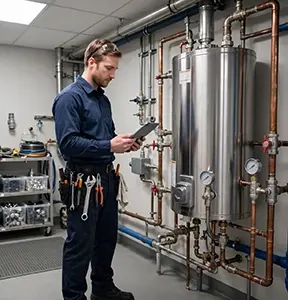 Hospitals illustrate this benefit with particular clarity. Consider a mid-sized hospital running dozens of critical systems: HVAC units controlling operating room air pressure, emergency generators required for power continuity, and autoclaves used for sterilizing surgical instruments. If an autoclave malfunctions at midnight, the on-call technician may never have serviced that specific unit before. A CMMS provides exact service history, including the last calibration date, prior repair notes, and manufacturer documentation, so that technician responds with confidence instead of guessing. The result is a faster fix and less risk to patient safety, since sterilization delays can affect surgical schedules the next morning.
School districts face a comparable challenge with far smaller maintenance teams spread across many buildings. A single maintenance department might cover ten schools with only a handful of technicians, and no one person can memorize the service history of every boiler, roof unit, and kitchen appliance across the district. A CMMS lets any technician assigned to an emergency call look up the specific building's equipment records before arriving on site, cutting diagnostic time significantly. This matters most during extreme weather events, when heating or cooling failures at multiple schools can happen simultaneously and staff need to prioritize the most urgent calls based on documented equipment risk.
Hotels present another strong case for this staffing benefit. Guest-facing emergencies, like a failed water heater during a full-occupancy weekend, demand fast resolution because guest complaints and refunds carry direct financial consequences. A CMMS gives night-shift maintenance staff, who may have less experience than senior day-shift technicians, access to documented procedures for common failures. This reduces the chance that an inexperienced technician makes the situation worse through improper troubleshooting, and it shortens the time a guest room stays out of service.
Accelerate your maintenance results
Pick the next step that fits you best: start your free trial or see MAPCON live with our team.
Turnover adds another layer to this argument. Maintenance departments across nearly every industry struggle with retention, and losing an experienced technician often means losing years of undocumented knowledge about how specific equipment behaves. A CMMS captures that knowledge as it happens, task by task, so departing employees leave behind a working record rather than a blank slate. New hires ramp up faster because they inherit documented history instead of starting from zero, which directly cuts the number of emergency calls caused by unfamiliarity with a specific asset.
Standard procedures stored within a CMMS also reduce variation in how different technicians handle the same type of failure. Without a documented process, one technician might address a refrigeration leak one way while another takes a completely different approach, and inconsistency like this increases the odds of a repeat failure. A CMMS attaches step-by-step procedures directly to work orders, so every technician follows the same validated process regardless of experience level. This consistency lowers the rate of repeat emergency calls tied to the same recurring issue, since the root cause gets addressed correctly the first time rather than patched temporarily.
Training also benefits from this centralized structure. New technicians learn faster when they can review notes left by more experienced colleagues on past work orders, including specific warnings about a temperamental valve or a part that requires a nonstandard tool. This kind of detail rarely makes it into a formal training manual, but it lives naturally within CMMS work order comments and asset notes. Over time, this builds a team-wide knowledge base that reduces dependency on any single person and keeps emergency response quality consistent across shifts, seasons, and staff changes.
Building a Maintenance Culture That Doesn't Rely on Luck
A maintenance department that avoids emergencies isn't necessarily lucky — it's organized. The teams that handle after-hours calls with confidence share documented histories, clear procedures, and a system that doesn't forget what one retired technician used to know. That kind of preparation doesn't happen by accident, and it rarely happens through good intentions alone. It comes from treating maintenance data as a shared resource rather than something locked in one person's head, and from giving every technician on every shift the same starting point when something breaks.
FAQs
How does CMMS reduce maintenance emergencies?
A CMMS reduces emergencies by scheduling preventive tasks automatically and giving technicians documented asset history, so small issues get caught before they cause a breakdown. This shifts maintenance from reactive firefighting to planned, consistent upkeep.
What is the main benefit of using a CMMS for preventive maintenance?
The main benefit is catching mechanical issues early through scheduled inspections rather than waiting for equipment to fail. MAPCON's CMMS automates these schedules so tasks never get missed or forgotten.
Can a CMMS help when an experienced technician leaves the company?
Yes, a CMMS preserves service history, procedures, and equipment notes so that knowledge doesn't leave with any single employee. New or on-call staff can access the same documented information a veteran technician would know.
Does a CMMS work well for facilities with small maintenance teams?
Yes, smaller teams benefit significantly since a CMMS lets any technician pull up equipment records instead of relying on one or two people to remember every asset's history. This is especially useful for districts or organizations managing several buildings with limited staff.
How does MAPCON's CMMS support after-hours or on-call maintenance response?
MAPCON's CMMS gives on-call technicians immediate access to an asset's full repair history and standard procedures, so they can diagnose issues faster without guessing. This reduces response time and lowers the risk of improper troubleshooting.
Does a CMMS reduce repeat equipment failures?
Yes, a CMMS attaches standard procedures to work orders so technicians address the root cause consistently instead of applying temporary fixes. This consistency lowers the chances of the same failure happening again.
MAPCON | 800-922-4336
Try Our CMMS Software Today!
MAPCON CMMS software empowers you to plan and execute PM tasks flawlessly, thanks to its wealth of features and customizable options. Want to see it for yourself? Click the button below to get your FREE 30-day trial of MAPCON!