




Published November 02, 2026
by mapcon
• Updated November 02, 2026
CMMS vs Manual Tracking: Moving from Invisible Repair Crew to Strategic Partner
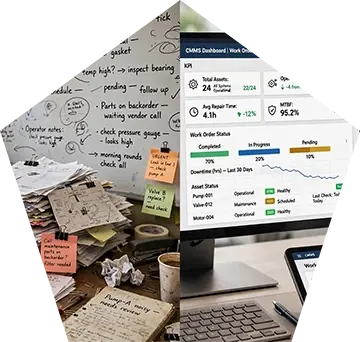 Maintenance teams work hard, yet many leadership teams still see maintenance as a cost center or a “repair crew.” When you rely on manual maintenance tracking, your work stays buried in notebooks, spreadsheets, and memories. A CMMS (computerized maintenance management system) changes that story and recasts maintenance as a strategic business function that drives revenue, safety, and asset life. This shift—from “fixers” to business operators—starts with how you track and present maintenance work.
Maintenance as a business function
Most organizations talk about maintenance only when something breaks. That mindset reduces maintenance to a reactive repair service. In reality, maintenance behaves like any other business function—it manages assets, controls risk, influences throughput, and protects margin.
In a mid-size food processing plant, for example, maintenance decisions affect product yield, regulatory compliance, and brand reputation. A bearing failure on a packaging line doesn’t just mean downtime; it can trigger missed shipments and quality issues that sales teams then have to explain to retailers. Leadership cares about those outcomes. They rarely see the maintenance behaviors that prevented ten similar failures in the last quarter, because those actions never left the maintenance team’s notebook.
This is where a core question arises: How can a CMMS help maintenance teams prove business value to leadership in a way manual tracking never can?
To answer that, look at what leadership actually expects from a business function: clear metrics, trend data, documented decisions, and financial impact.
Why manual tracking hides maintenance value
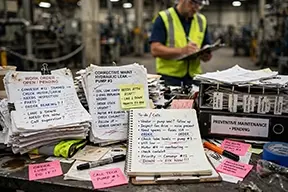 Manual tracking—paper work orders, whiteboards, scattered spreadsheets—creates a busy environment without a clear record of impact. Work gets done, but proof of value rarely exists in a format leaders trust.
In a logistics warehouse, a technician may track forklift repairs in a spreadsheet. Another tech uses a notebook. The maintenance manager holds a mental map of which units fail frequently. When the COO asks, “What is our annual maintenance cost per forklift compared to downtime losses?” the team scrambles. They dig through binders, reconcile inconsistent formats, and guess at labor hours never captured. The answer arrives late and incomplete. Leadership walks away with a story that maintenance lacks data discipline.
Manual tracking often causes these issues:
- Fragmented records. Work orders sit across email threads, paper forms, and ad hoc lists.
- Unreliable history. Asset histories depend on who remembered to write down the work and how detailed the notes were.
- Weak link to finance. Parts usage and labor hours rarely tie directly to cost accounts in a way a CFO can review.
- Limited KPI tracking. Calculations like mean time between failures (MTBF) or schedule compliance depend on tedious manual aggregation, so teams avoid them.
The result: maintenance appears busy but not measurable. Without metrics, the business function looks informal and reactive, and leadership continues to treat it as overhead.
Maintenance software that delivers real value
MAPCON helps maintenance teams stay ahead of work orders, support better decisions, and reduce downtime.
How a CMMS reframes maintenance for leadership
A CMMS gathers work orders, asset data, parts, and labor into a single system that produces repeatable, auditable metrics. Instead of scattered records, you hold a portfolio of maintenance activity that looks and behaves like any other business function’s data set.
Across industries, this reframing shows up clearly:
- Brewing industry example. A craft brewery that moved from manual work orders to a CMMS now stores all maintenance information in the cloud—equipment histories, task completion times, and downtime events. When leadership reviews production performance, maintenance can show which interventions kept bottling lines available during peak demand. The CMMS transforms their narrative from “we fix things” to “we protect capacity.”
- Airport operations example. In an airport maintenance case study, structured maintenance management improved business processes and supported better decisions about asset upgrades. With systematic data, maintenance leaders could participate directly in cost–benefit analyses for infrastructure investments, not just respond to failures.
When leadership asks about value, a CMMS provides:
- Consistent KPIs. MTBF, work completion rates, backlog levels, and planned vs. unplanned work become available at a click.
- Clear cost tracking. Every work order carries parts and labor data, making cost per asset or line easier to calculate.
- Service-level visibility. Response times and schedule adherence for preventive work show up in dashboards, similar to how customer service reports ticket handling.
Instead of defending maintenance budgets with anecdotes, you can show graphs, ratios, and trends that finance teams respect.
Turning work orders into business data
With manual tracking, a work order is a piece of paper. With a CMMS, a work order becomes a data record that feeds asset history, labor metrics, and cost information.
Consider three practical transformations:
1. From “Job completed” to measurable performance.
A technician closes a job in the CMMS after replacing a conveyor motor. The system records time of failure, repair duration, parts cost, and associated line. Over months, maintenance can measure average repair time per line and show leadership how investments in training or tools cut that time, returning production capacity sooner.
2. From scattered notes to asset narratives.
Each asset in the CMMS maintains a timeline of inspections, repairs, and parts changes. When the production director wants to know why one packaging machine causes more late orders than others, maintenance can pull detailed histories. That insight supports decisions about replacement, redesign, or process changes.
3. From reactive lists to credible forecasting.
A CMMS allows for basic forward-looking views. For example, the system can show that next quarter requires a concentrated set of preventive inspections on high-value assets. With manual tracking, that workload often catches management by surprise; with a CMMS, maintenance leaders can discuss resource needs in advance with HR and finance.
Work orders no longer act as loose tasks; they become structured evidence of how maintenance activity supports revenue, safety, and quality.
Accelerate your maintenance results
Pick the next step that fits you best: start your free trial or see MAPCON live with our team.
Leadership language: translating maintenance into business terms
 One reason maintenance lacks influence in budget conversations is language. Manual tracking keeps discussions technical: “We replaced three valves and a pump.” Leadership responds to business language: “We reduced unplanned downtime by 12 hours this month, which preserved an estimated 18,000 units of output.”
A CMMS supports this translation by:
- Attaching downtime minutes to specific assets and lines. This data links directly to production loss estimates.
- Capturing labor hours per work order. Maintenance can demonstrate where time went and where bottlenecks exist, just like operations team capacity studies.
- Recording completion rates for preventive work. With that information, leaders see how disciplined maintenance practices correlate with fewer breakdowns and lower emergency spending.
In a packaging plant, the maintenance manager once walked into the quarterly review with only a stack of completed paper work orders. After adopting a CMMS, that manager now arrives with a concise slide: unplanned downtime trend, preventive completion percentage, maintenance cost per production hour, and safety incidents linked to equipment condition. Leadership immediately sees maintenance as a managed business function with clear accountability.
Case examples: maintenance as a strategic lever
Examples from various sectors show how moving from manual tracking to a CMMS elevates maintenance:
- Manufacturing and regulatory compliance. A chemical processor must document inspections and repairs for regulatory audits. Manual logs often contain incomplete dates and descriptions. After implementing a CMMS, every inspection appears with timestamp, technician, and checklist results. Auditors now review structured reports. The business saves time during audits and maintains its operating license without last-minute panic. Leadership recognizes maintenance as a guardian of regulatory risk, not a back-room service.
- Facilities and tenant satisfaction. In a large commercial building, tenants report issues through emails and calls. Manual tracking leaves some requests unresolved or delayed. With a CMMS and a work request portal, every tenant ticket receives a work order and status. Maintenance can measure average time to resolution and correlate that with tenant retention and lease renewals. The property manager now sees maintenance as a contributor to customer experience and revenue stability.
- Fleet operations and safety. A distribution company tracks truck repairs on paper forms drivers hand in weekly. Near-misses and minor issues sometimes go undocumented. After adopting a CMMS tailored for fleet assets, the company logs every inspection and repair digitally. Management now reviews trends in brake issues, tire failures, and safety-related repairs. Reduced incidents translate into lower insurance costs and fewer accidents. Leadership sees maintenance as an active risk management partner.
In each case, the CMMS does more than support daily work—it supplies the evidence that maintenance drives business outcomes.
How CMMS usage answers the core SEO question
Earlier, this article posed a key question: How can a CMMS help maintenance teams prove business value to leadership in a way manual tracking never can?
Here is the direct answer:
A CMMS allows maintenance teams to capture every work order, asset event, part change, and labor hour in a structured, searchable format. With that platform, teams can calculate KPIs, associate downtime with lost revenue, document compliance actions, and present trends over time. Manual tracking cannot reliably produce those outputs at scale. Leadership receives dashboards and reports that mirror other business functions, making it easier to justify budgets, headcount, and capital projects.
Where manual tracking leaves maintenance invisible, a CMMS makes maintenance legible in the language of business.
Moving from invisible repair crew to visible business partner
Maintenance teams already protect assets, safeguard workers, and sustain customer commitments. The issue is not effort; the issue is visibility. Manual tracking keeps maintenance impact locked in notebooks and ad hoc spreadsheets. Leadership sees the cost, but not the value.
By adopting a CMMS and treating maintenance as a business function, organizations give maintenance leaders a platform for data, metrics, and narrative. They start presenting maintenance results in the same way operations, finance, and sales report their performance. Over time, that visibility changes budget conversations, shapes strategic decisions, and gives maintenance teams a clear role in long-term planning.
If maintenance currently feels like an invisible repair crew in your organization, the path toward recognition does not start with more tools on the shop floor—it starts with better tracking, better reporting, and a CMMS that turns every maintenance action into business evidence.
FAQs
What is a CMMS and how does it support maintenance as a business function?
A CMMS centralizes work orders, asset data, and maintenance history so teams can measure performance, control costs, and report value to leadership.
How does manual maintenance tracking make it hard to prove value to leadership?
Manual tracking scatters data across paper and spreadsheets, which makes KPIs, cost analysis, and downtime trends difficult to present in a credible way.
What benefits can MAPCON’s CMMS provide for organizations using manual tracking today?
MAPCON’s CMMS replaces manual processes with automated work order management, asset histories, and maintenance reporting that leadership can trust.
How does a CMMS help connect maintenance activities to financial outcomes?
A CMMS records labor, parts, and downtime per asset so maintenance managers can link work directly to production losses, savings, and budget needs.
Can a CMMS improve communication between maintenance teams and executives?
Yes, a CMMS provides dashboards and reports that translate technical maintenance activity into clear metrics executives understand.
Is MAPCON’s CMMS suitable for small and mid-sized businesses?
MAPCON’s CMMS scales for small and mid-sized companies, giving them enterprise-style asset tracking and maintenance reporting without complex overhead.
MAPCON | 800-922-4336
Try Our CMMS Software Today!
MAPCON CMMS software empowers you to plan and execute PM tasks flawlessly, thanks to its wealth of features and customizable options. Want to see it for yourself? Click the button below to get your FREE 30-day trial of MAPCON!