




Published January 01, 2025
by Stephen Brayton
• Updated June 07, 2026
The New Era of Maintenance: AI Tools That Elevate the Technician's Role
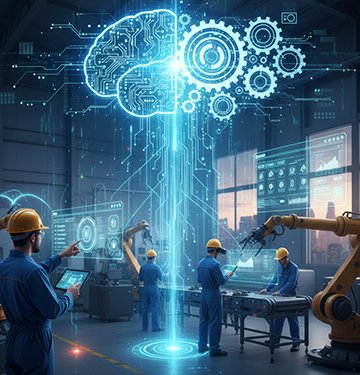 The world of industrial and facility maintenance evolves at a dizzying pace. As complex machinery and smart systems become standard, maintenance teams face increasing demands on their time and expertise. This shifting landscape brings with it the rise of Artificial Intelligence (AI) tools, which some view with apprehension, fearing they signal the obsolescence of the human worker. The truth is much more promising: AI is not a replacement for skilled technicians; it acts as a powerful co-pilot, fundamentally changing the job for the better. This blog explores how AI tools are upskilling the maintenance team, enabling technicians to move away from tedious data retrieval and paperwork toward focusing on complex, hands-on repairs.
AI as the Ultimate Virtual Assistant for Technicians
Imagine a tool that provides instant, precise guidance the moment a technician encounters an unfamiliar fault. This describes the core value of AI in the maintenance field today. Instead of representing a distant, futuristic concept, AI functions as a practical, day-to-day virtual assistant. It delivers necessary information precisely when the technician needs it most, cutting down dramatically on diagnostic time. Technicians spend less time searching through binders or navigating complex digital libraries and more time turning wrenches and solving problems.
AI’s Instant Troubleshooting Guidance
A major challenge for any maintenance technician, especially those new to a particular asset or system, involves diagnosing the root cause of an unexpected failure. Traditional methods necessitate cross-referencing manuals, searching outdated knowledge bases, or calling a supervisor who may also lack the immediate answer. AI changes this process entirely. Trained on mountains of equipment data, technical manuals, and historical work orders, AI systems can process fault codes and observed symptoms in seconds.
Technicians simply input the error message or a description of the equipment behavior into a tablet or headset interface. The AI instantly generates a prioritized list of potential causes and, crucially, the specific, step-by-step procedures to verify and fix each one. This immediate access to vetted, expert-level knowledge effectively puts the most experienced troubleshooter on the team right alongside the newest hire. This instant guidance accelerates the professional development of every team member, building confidence and competence with every successful repair.
Summarizing Vast Maintenance Histories
Every piece of machinery possesses a history—a complex chronicle of repairs, parts replacements, and operational quirks. Understanding this history is often critical to fixing a current issue. For instance, knowing a specific pump failed three times in the last year due to bearing wear suggests a systemic vibration problem rather than a random component failure. Retrieving this history traditionally requires navigating dense Computerized Maintenance Management System (CMMS) records, a tedious, time-consuming process.
AI excels at rapidly synthesizing this kind of vast, unstructured data. A technician can ask the AI, "What work occurred on Boiler 4's feedwater pump in the last two years?" The AI doesn't dump thousands of records onto the screen; it generates a concise summary. It highlights common failure modes, identifies parts that experienced unusually frequent replacement, and even flags recent procedural changes. This capability transforms the technician’s approach from reactive component replacement to informed, data-driven system correction. The AI extracts the necessary intelligence, giving the human technician the context needed for a superior repair strategy.
Accelerate your maintenance results
Pick the next step that fits you best: start your free trial or see MAPCON live with our team.
Freedom from Paperwork: Focusing on Skilled Work
A significant portion of a technician's day often involves documentation, reporting, and paperwork—tasks that take them away from hands-on repair work. These tasks include closing out work orders, manually recording fault details, logging hours, and ordering necessary parts. While critical for compliance and asset management, these activities demand attention better spent on applying specialized craft skills. AI provides compelling solutions to this workload.
Voice-Activated Work Order Closure
Modern AI tools allow technicians to close out a work order entirely through voice commands while standing next to the repaired machine. Instead of typing detailed notes on a small mobile device keyboard, the technician simply narrates the repair process: "Replaced the hydraulic manifold block. Flushed the lines. Tested the system for thirty minutes; pressure held steady at 2,000 PSI."
The AI listens, transcribes the notes, automatically associates the verbalized parts (e.g., "hydraulic manifold block") with the correct inventory codes, and updates the asset's history. This instant, accurate documentation drastically reduces the non-wrench time technicians must spend back in the office. It keeps the data fresh and detailed, improving the quality of the maintenance record without burdening the technician.
Automating Routine Data Entry
Furthermore, AI can interpret data captured by connected equipment sensors and automatically populate certain fields in the CMMS. For example, if a machine reports a high vibration alarm, and the technician verifies a loose motor mount, the AI can pre-fill the work order with the alarm's time stamp, the fault code, and the affected component. The human only needs to confirm the root cause and describe the resolution. By automating routine data entry, AI elevates the technician’s role from data clerk to skilled analyst and craftsperson. The technology handles the administrative chores, allowing human talent to concentrate on the complex mechanical and electrical tasks that require judgment, dexterity, and experience.
Elevating the Human Element: The Future Skill Set
AI is not about removing the technician; it's about redefining what a maintenance technician does. The future of the maintenance workforce centers on higher-level thinking, complex diagnosis, and specialized repair execution. AI systems handle the repetitive, data-heavy, and informational tasks, creating a clear need for technicians to cultivate skills that computers cannot replicate.
The Rise of the System Integrator and Analyst
When AI provides instant diagnosis and historical context, the technician's role shifts. They become less of a generalist troubleshooter and more of a system integrator and analyst. They must possess the critical thinking skills to evaluate the AI’s suggestions, using their sensory input (sound, smell, touch) and years of experience to validate the information. The AI might suggest three possible causes; the technician’s experience determines which one is most likely given the machine's specific environment and operational context.
This requires advanced training in areas like machine learning fundamentals, data interpretation, and advanced controls. Technicians become collaborators with the AI, supervising the machine's analysis and applying their hands-on knowledge to the physical world. This career trajectory promises more intellectual engagement and higher compensation, attracting a new generation of talent to the maintenance trades.
Maintenance software that delivers real value
MAPCON helps maintenance teams stay ahead of work orders, support better decisions, and reduce downtime.
The Unreplaceability of Manual Dexterity and Judgment
No matter how advanced the AI, it remains incapable of performing the physical act of maintenance. AI cannot safely lock out a machine, weld a cracked frame, align a complex drive shaft, or carefully thread a pipe. These tasks require manual dexterity, three-dimensional spatial reasoning, and practical judgment in unpredictable, real-world environments.
Furthermore, AI cannot perceive the nuanced, non-quantifiable details that a human technician recognizes—the subtle variation in the hum of a motor, the faint smell of burning oil that precedes a catastrophic failure, or the slight discoloration on a circuit board indicating overheating. These human senses and judgment remain paramount. AI tools serve to make the time spent on these irreplaceable tasks more efficient, more focused, and therefore, more valuable. Maintenance professionals who blend their traditional trade skills with a proficiency in leveraging AI assistants secure their place in the industry’s future.
AI and Maintenance: Focusing on the Human-Machine Partnership
The integration of AI tools marks a genuine evolution in the industrial sector, establishing a potent human-machine partnership. This partnership moves maintenance teams beyond reactive repair cycles into a state of proactive, informed asset care. The successful organizations of tomorrow are those that view AI technology not as a cost-cutting measure for labor, but as a crucial investment in their existing, skilled personnel.
The true value of these digital assistants resides in their capacity to elevate every team member, making the most junior technician functional faster and allowing the most senior technician to dedicate their profound knowledge to the toughest, most challenging systemic issues. This shift strengthens the maintenance workforce, making the work more engaging, knowledge-intensive, and professionally rewarding.
The Skilled Future of the Technician
The adoption of artificial intelligence guarantees that the maintenance technician's job will be richer, more analytical, and more specialized. Instead of fearing obsolescence, technicians will embrace new roles as informed decision-makers who direct the actions of powerful digital tools. This commitment to technician development and technology integration secures a competitive advantage for industry and a fascinating, intellectually satisfying career path for the people who keep our world running.
Frequently Asked Questions About AI in Maintenance
How do AI tools currently assist maintenance technicians?
AI acts as a virtual assistant, providing instant troubleshooting guidance, accessing summarized maintenance histories, and automating routine paperwork like work order closure.
Will AI replace the skilled maintenance workforce?
No, AI will not replace technicians; it redefines their role by handling repetitive data tasks and allowing humans to focus on complex diagnosis, judgment, and hands-on repair skills.
What is the main benefit of AI integration for daily maintenance work?
The main benefit is reducing "non-wrench time"—the time spent on paperwork and searching for information—allowing technicians to dedicate more time to skilled, physical repairs.
How does AI help technicians with equipment history?
AI rapidly synthesizes vast CMMS records to provide concise summaries of an asset's repair history, highlighting common failure modes and key incidents.
What new skills will maintenance technicians need in an AI-integrated environment?
Technicians will need to develop skills as system analysts and integrators, using critical thinking to validate AI suggestions and apply their trade knowledge.
Does AI perform the physical work of maintenance?
No, AI cannot perform the physical tasks like welding, aligning equipment, or installing parts; these require human dexterity, sensory input, and practical judgment.
MAPCON | 800-922-4336
Try Our CMMS Software Today!
MAPCON CMMS software empowers you to plan and execute PM tasks flawlessly, thanks to its wealth of features and customizable options. Want to see it for yourself? Click the button below to get your FREE 30-day trial of MAPCON!