




Published February 23, 2026
by Stephen Brayton
• Updated June 07, 2026
AI-Managed CMMS Operations and Energy-Conscious Maintenance Planning
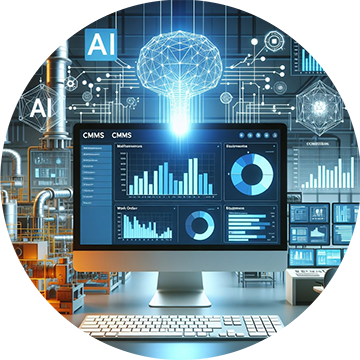 Improving energy use across facilities requires more than newer equipment or lower utility rates. The concept behind improving energy use through AI-managed CMMS operations centers on how maintenance decisions affect energy draw long after a work order closes. This article explores how artificial intelligence reshapes CMMS platforms to coordinate maintenance actions that limit energy waste while keeping equipment within high-efficiency operating ranges.
Energy Waste as a Maintenance Problem
Energy loss often traces back to maintenance timing, repair quality, and operating conditions rather than equipment age alone. A pump repaired during peak utility pricing may require extended testing cycles that drive up costs. A motor returned to service without proper calibration may run reliably while consuming excess power for months.
Traditional CMMS platforms record maintenance history and schedule tasks, yet they rarely connect those actions to energy outcomes. Work orders close successfully while energy bills continue to climb. AI changes that relationship by treating energy consumption as a performance metric tied directly to maintenance execution.
How AI Changes the Role of CMMS Platforms
AI-enhanced CMMS platforms move beyond digital recordkeeping. These systems ingest operational data, maintenance logs, and utility pricing structures into a unified decision layer. Instead of asking only whether equipment needs service, the system evaluates when and how that service should occur to support efficient energy use.
This coordination allows maintenance teams to view energy impact alongside labor availability, spare parts inventory, and production schedules. The result shifts maintenance planning from reactive task completion toward energy-aware operational control.
Coordinated Decision Logic
AI-driven CMMS platforms apply rule-based and statistical models to coordinate maintenance actions. These models weigh factors such as:
- Real-time equipment load levels
- Utility rate schedules and demand charges
- Historical post-repair energy performance
- Environmental conditions affecting efficiency
By processing these inputs together, the CMMS suggests maintenance windows that reduce unnecessary energy draw without disrupting production.
Accelerate your maintenance results
Pick the next step that fits you best: start your free trial or see MAPCON live with our team.
Aligning Maintenance Timing with Utility Cost Structures
Utility pricing rarely stays flat. Time-of-use rates, peak demand penalties, and seasonal adjustments shape the true cost of running equipment. AI-managed CMMS platforms analyze these pricing models and align maintenance execution accordingly.
Off-Peak Maintenance Execution
When a chiller requires cleaning or recalibration, AI scheduling engines can prioritize off-peak hours where testing and restart cycles cost less. This approach matters in facilities where equipment commissioning consumes significant power.
In large commercial buildings, for example, HVAC systems often undergo airflow balancing after maintenance. AI scheduling shifts those tasks away from peak afternoon pricing, reducing cost without delaying service.
Industrial Manufacturing Example
In automotive manufacturing plants, compressed air systems represent a major energy expense. AI-managed CMMS platforms coordinate maintenance on compressors during periods of lower electricity pricing while production lines slow. The system accounts for ramp-up energy usage after repairs and schedules verification runs during lower-cost intervals.
This coordination reduces waste while preserving output targets.
Ensuring Equipment Returns to Peak Energy Performance
Maintenance success does not end when equipment restarts. Many assets operate reliably after repair while drifting away from their most efficient operating envelope. AI-enhanced CMMS platforms track post-maintenance energy performance to ensure repairs restore efficiency, not just functionality.
Performance Envelope Validation
After a motor replacement or bearing service, AI systems compare expected energy consumption against actual readings. Deviations trigger follow-up actions such as alignment checks, lubrication adjustments, or control parameter tuning.
This process helps maintenance teams catch energy losses early rather than discovering them through elevated utility bills months later.
Data-Driven Quality Control
AI treats energy efficiency as a quality metric for maintenance work. If similar repairs consistently lead to higher energy use, the CMMS flags procedural issues or training gaps. This feedback loop improves maintenance standards while reducing long-term energy waste.
Integrating Asset Performance Data with Energy Metrics
AI-managed CMMS platforms excel at connecting datasets that once lived in isolation. Asset condition metrics, sensor readings, and maintenance histories merge with energy consumption profiles to reveal actionable patterns.
Maintenance software that delivers real value
MAPCON helps maintenance teams stay ahead of work orders, support better decisions, and reduce downtime.
Identifying Energy-Intensive Maintenance Outcomes
In water treatment facilities, pump maintenance often focuses on flow reliability. AI-driven analysis reveals how impeller wear or seal replacement affects kilowatt-hour consumption per volume pumped. Maintenance teams then adjust service procedures to favor energy-efficient outcomes.
This insight allows facilities to prioritize maintenance actions that deliver the greatest energy savings rather than treating all repairs equally.
Retail Distribution Centers
Conveyor systems in distribution centers run continuously and consume large amounts of power. AI-managed CMMS platforms analyze motor temperature, vibration, and energy draw together. When maintenance restores smooth operation, the system verifies that power usage drops to expected levels before closing the energy performance loop.
Coordinating Maintenance Across Interconnected Systems
Energy waste often arises from poor coordination between interconnected assets. Servicing one component without accounting for system-wide effects leads to inefficiencies. AI-enhanced CMMS platforms understand asset relationships and coordinate maintenance accordingly.
HVAC System Coordination
In hospitals, air handlers, chillers, and control systems interact closely. AI scheduling ensures that sensor calibration, valve servicing, and software updates occur in sequences that prevent energy spikes. The CMMS accounts for how one maintenance action affects downstream loads.
This orchestration reduces the need for repeated testing and avoids prolonged operation in inefficient states.
Food and Beverage Processing
Refrigeration systems in food processing plants require precise coordination. AI-managed CMMS platforms schedule maintenance across compressors, condensers, and evaporators to minimize energy draw during restart cycles. This approach protects product quality while controlling power usage.
Reducing Energy Waste Through Maintenance Standardization
AI improves CMMS effectiveness by standardizing maintenance execution based on energy outcomes. Instead of relying on individual technician habits, the system enforces best practices tied to efficiency targets.
Procedural Guidance
When technicians open work orders, AI-enhanced CMMS platforms present step sequences designed to support energy-efficient operation. These steps may include torque specifications, calibration thresholds, or control settings known to reduce power consumption.
By embedding energy considerations into daily maintenance workflows, the system reduces variability that leads to waste.
Continuous Improvement Loops
As the CMMS collects data on energy outcomes, AI refines maintenance procedures over time. Tasks that consistently yield lower energy usage receive higher priority, while inefficient methods undergo revision.
This learning process keeps maintenance programs aligned with evolving operational demands.
AI’s Role Beyond Failure Prevention
While predictive analytics often receive attention, AI-managed CMMS platforms deliver value even without deep failure forecasting. Their strength lies in coordination, context, and decision support.
AI helps maintenance teams understand the energy consequences of routine actions. It connects scheduling decisions to utility costs and repair quality to long-term consumption. This perspective transforms CMMS platforms into tools for operational efficiency rather than simple task managers.
Industry-Wide Impact on Energy Management Strategies
 As energy costs rise and sustainability targets tighten, organizations look beyond capital upgrades for savings. Maintenance practices offer a controllable lever for reducing consumption.
AI-managed CMMS platforms support this shift by making energy-aware maintenance practical at scale. Facilities gain the ability to align daily actions with broader energy management strategies without adding administrative burden.
Energy-Aware Maintenance as an Operational Advantage
AI-managed CMMS operations reshape how organizations view maintenance value. Energy efficiency no longer depends solely on equipment design or operator behavior. It becomes a measurable outcome of coordinated maintenance decisions informed by data, timing, and performance feedback.
As facilities continue to face rising energy costs and regulatory pressure, maintenance teams equipped with AI-enhanced CMMS platforms gain a clear operational advantage. Energy-conscious maintenance planning moves from aspiration to daily practice, reshaping how facilities manage both assets and resources.
FAQs
How does AI improve energy efficiency in CMMS-driven maintenance?
AI links maintenance actions with energy usage data so teams can schedule and execute work in ways that reduce unnecessary power consumption.
Can a CMMS help reduce utility costs without replacing equipment?
Yes, a CMMS can lower energy waste by aligning maintenance timing and repair quality with actual energy performance data.
What role does maintenance timing play in energy management?
Maintenance completed during high-rate utility periods or inefficient operating states often raises energy costs even when repairs succeed.
How does AI-managed maintenance affect equipment energy performance after repairs?
AI reviews post-repair energy use to confirm equipment returns to its intended efficiency range instead of operating in a power-intensive condition.
Is AI in CMMS only used for predicting failures?
No, AI also supports energy-aware scheduling, maintenance quality control, and coordination across connected systems.
How does a modern CMMS support energy-conscious maintenance strategies?
A modern CMMS combines asset data and operational insights so maintenance teams can see how work orders influence ongoing energy use.
MAPCON | 800-922-4336
Try Our CMMS Software Today!
MAPCON CMMS software empowers you to plan and execute PM tasks flawlessly, thanks to its wealth of features and customizable options. Want to see it for yourself? Click the button below to get your FREE 30-day trial of MAPCON!