




Published December 01, 2025
by Stephen Brayton
• Updated June 07, 2026
AI and the Future of Maintenance: The Manager's Dialogue with a CMMS
 The Computerized Maintenance Management System (CMMS) long served as the central hub for maintenance data, organizing the chaos of work orders, asset histories, and inventory logs. Today, the integration of Artificial Intelligence (AI) into these platforms shifts the CMMS from a mere record-keeper to a source of genuine operational intelligence. Let's discuss AI and the future of maintenance.
This evolution changes the very nature of the maintenance manager’s job. Instead of simply pulling reports, the manager now interacts with an intelligent system, asking sophisticated questions that move the department beyond reactive repair. This AI-CMMS partnership promises a proactive, insightful approach to facility and industrial upkeep. The real question becomes: what queries would a discerning maintenance manager pose to this new AI platform, specifically focusing on core internal operations such as assets, inventory, and workflow, rather than solely on predicting equipment failure?
Asset Health and Maintenance Strategy Inquiry
Assets represent the lifeblood of any industrial or facility operation—from pharmaceutical clean rooms to municipality water pumps. A maintenance manager's primary interest lies in maximizing asset utility and understanding risk. AI, with its capacity to analyze vast, complex data sets, helps managers make high-stakes, nuanced decisions about their equipment.
Deeper Asset Insights
Instead of asking what broke, the manager asks the AI to synthesize patterns from the past to refine future action. For example, a manager in a food and beverage bottling plant might inquire: "Compare the Mean Time Between Failures (MTBF) for all high-speed filler machines installed before 2018 versus those installed after, adjusting for production volume variances." This pinpoints whether newer technology or older, well-understood equipment provides better value.
A manager overseeing a healthcare facility might ask: "List all critical HVAC units showing a 15% increase in corrective maintenance costs over the last six months, and identify the common parts or labor codes used across those work orders." This moves beyond simple cost tracking, flagging systemic issues—perhaps a poor installation standard or a common technician training gap—that require immediate, targeted intervention.
For complex, multi-component assets, the AI becomes invaluable. "What percentage of overall asset downtime in our mining fleet relates directly to auxiliary component failure, not the primary engine, and what geographical locations show the highest concentration of these specific failures?" This assists a mining operation manager in prioritizing which peripheral systems require more robust preventive schedules in remote, difficult-to-reach areas.
Accelerate your maintenance results
Pick the next step that fits you best: start your free trial or see MAPCON live with our team.
Inventory Management and Supply Chain Intelligence
For the maintenance manager, inventory control involves much more than simply counting parts. It affects work order completion times, capital tied up in the storeroom, and the speed of recovery from an unplanned breakdown. The AI-CMMS transforms the storeroom into an intelligent supply chain node.
Intelligent Spare Parts Management
Managers need to know they possess the right part at the right time. A query to the AI in a wastewater treatment plant focuses on risk: "Identify all assets listed as 'Critical' that use a unique spare part currently at or below the reorder point, factoring in the current procurement lead time for each part." This generates an exception list requiring immediate attention, prioritizing parts based on asset criticality, not just quantity on hand.
A manager in the electronics manufacturing sector faces a constantly changing parts landscape. They might ask: "For parts we have not used in over three years, cross-reference their associated assets' remaining useful life. Recommend parts for disposal where the corresponding asset is slated for decommissioning within 12 months." This clears out slow-moving inventory tied to sunsetting equipment, releasing working capital.
The AI also helps managers understand vendor performance relative to their operational needs. "Which vendors consistently deliver high-priority parts two or more days late, and what percentage of work orders experience a subsequent delay due to this late delivery?" This allows a maintenance manager in power generation to engage in data-driven conversations with suppliers, or to seek alternative sources.
Work Order Flow and Labor Allocation Analysis
Work orders represent the actual execution of maintenance strategy. Managers constantly strive to distribute workload effectively and understand where the bottlenecks occur. An AI-CMMS moves beyond simple status reports, offering deep analysis of human and process efficiency.
Workload Balancing and Technician Performance
Managers want to know the true cost and impact of work. A facilities manager for a university campus might ask: "Analyze all urgent, unplanned work orders from the last quarter. For which technicians did the estimated time to complete (ETC) most frequently exceed the actual time to complete (ATC) by over 50%?" This query does not judge performance harshly; instead, it identifies technicians who might need additional training, better diagnostic tools, or clearer work instructions, focusing on supporting the workforce.
In a commercial property management setting, the AI can assist with resource allocation across multiple sites. "If we shifted two preventative maintenance technicians from the West Loop site to the Downtown Tower site, what would be the predicted impact on the overall percentage of on-time work order completions at both locations next month?" This provides a simulation to help balance workload proactively, ensuring personnel are deployed where they contribute most effectively to service level agreements.
The AI helps in refining the work order process itself. "What are the top three failure codes that most frequently correlate with work orders closed without a root cause analysis, and what is the average subsequent Mean Time To Repair (MTTR) for the assets involved?" This encourages a deeper, more investigative approach to recurring issues, rather than quick fixes.
Maintenance software that delivers real value
MAPCON helps maintenance teams stay ahead of work orders, support better decisions, and reduce downtime.
Reporting, Compliance, and Audit Readiness
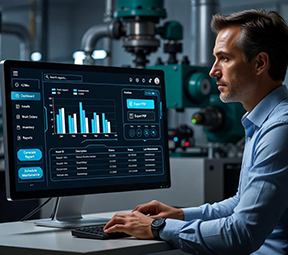 The ability to generate accurate, accessible reports is a foundational CMMS function. AI elevates reporting by providing synthesis and context, making data instantly audit-ready and useful for strategic planning.
Automated Compliance and Risk Assessment
Compliance remains a major focus for many industries. A manager in the aerospace manufacturing sector might ask the AI: "Generate a report detailing the work order history for all assets involved in the final assembly line that have a regulatory inspection due within 45 days. Highlight any open, overdue, or incomplete safety checks." This delivers a targeted, pre-audit brief, ensuring no critical regulatory step is missed.
Beyond compliance, the AI helps in long-term capital planning. "Provide a five-year rolling projection of total replacement costs for all assets in the water distribution network, categorized by their current condition rating and total historical maintenance expense, assuming current annual maintenance budget growth." This helps a municipal public works manager justify capital expenditure for asset replacement, using detailed, historic financial data rather than rough estimates.
Advancing Maintenance Culture Through Inquiry
The integration of AI into a CMMS represents a major shift from data collection to data utilization. Maintenance managers now possess a tool capable of synthesizing internal operational data—assets, inventory, work orders, and historical reports—into actionable intelligence. This new dialogue with the AI platform transforms the manager into a strategic leader, asking nuanced questions that reveal hidden inefficiencies, improve technician support, and drive precise capital investment decisions. This technological evolution makes maintenance a predictive, informed, and highly valued component of the organization's success.
Frequently Asked Questions (FAQs)
What core operational areas does AI enhance within a CMMS?
AI significantly improves asset health analysis, intelligent spare parts inventory management, effective work order scheduling, and detailed compliance reporting.
How does AI help maintenance managers with asset strategy?
AI analyzes historical repair and production data to refine equipment preventive maintenance schedules and determine optimal capital replacement timing.
Can AI in a CMMS improve spare parts inventory control?
Yes, AI identifies critical parts tied to high-priority assets, optimizes reorder points based on usage and lead times, and flags obsolete or slow-moving stock.
What specific type of questions about work orders can AI answer?
Managers can ask AI to analyze workload distribution across technicians, identify bottlenecks in the maintenance workflow, and correlate specific failure codes with required labor skills.
How does an AI-powered CMMS, like one from MAPCON, assist with regulatory compliance?
A MAPCON CMMS with AI can automatically generate targeted, pre-audit reports that highlight incomplete safety checks and required documentation for assets with upcoming inspections.
Does AI in maintenance only focus on predicting failures?
No, AI focuses heavily on optimizing internal operations, including resource allocation, maintenance cost control, and improving overall data-driven decision-making, in addition to predictive analytics.
MAPCON | 800-922-4336
Try Our CMMS Software Today!
MAPCON CMMS software empowers you to plan and execute PM tasks flawlessly, thanks to its wealth of features and customizable options. Want to see it for yourself? Click the button below to get your FREE 30-day trial of MAPCON!