




Published December 24, 2025
by Stephen Brayton
• Updated June 07, 2026
Optimizing Maintenance Costs: A Guide to Cost Efficiency with CMMS
Understanding Maintenance Cost Efficiency
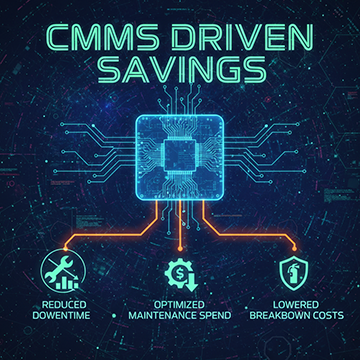 Cost efficiency in maintenance refers to maximizing the return on investment for every dollar spent on labor and resources, including inventory, assets, and utilities.
A cost-efficient maintenance program means that you use resources to achieve optimal equipment performance and minimize expenses.
Let's explore optimizing maintenance costs with efficiency from a computerized maintenance management system (CMMS).
Doing so justifies maintenance budgets to upper management.
You prioritize tasks and allocate resources effectively.
By demonstrating efficient resource utilization, maintenance managers can secure necessary funding and demonstrate the value of their department.
Why Cost Efficiency Matters
Let's go more into detail with some points on the importance of understanding maintenance cost efficiency.
- Budget Justification: As mentioned above, operating a proper maintenance program strengthens the case for budget requests and helps to increase the continued support from upper management.
- Resource Prioritization: This means both labor and inventory. Cost efficiency analysis helps you stock the correct quantity of the correct parts.
- You don't want too many of a part you won't use often.
- On the other hand, you don't want to have an empty bin when an emergency or unplanned failure occurs.
- On the labor side, cost efficiency includes having the skilled technicians needed for the various maintenance jobs.
- Performance Improvement: By optimizing maintenance processes, cost efficiency contributes to improved equipment performance, reduced downtime, and increased overall productivity.
- Improved Return On Investment (ROI): Ultimately, cost efficiency translates to a better return on investment for maintenance activities, demonstrating the department's contribution to the company's bottom line.
Maintenance software that delivers real value
MAPCON helps maintenance teams stay ahead of work orders, support better decisions, and reduce downtime.
How to Calculate Maintenance Cost Efficiency
Calculating cost efficiency involves a systematic approach that includes defining objectives, gathering data, and analyzing results.
A computerized maintenance management system (CMMS) plays a vital role in organizing this process.
Step 1: Define Objectives and Metrics
Before measuring cost efficiency, clearly define maintenance objectives.
Common objectives include minimizing downtime, reducing maintenance costs, and maximizing equipment uptime.
A maintenance supervisor should meet and discuss these goals with the team.
Once you choose the objectives, select appropriate metrics to track progress.
Examples include:
- Mean Time to Repair (MTTR): Measures the average time required to restore a failed system or device to full functionality.
- A lower MTTR indicates a more efficient repair process.
- MTTR = Total Downtime / Number of Repairs
- A higher MTBF reflects greater system reliability.
- MTBF = Total Operating Time / Number of Failures
- Overall Equipment Effectiveness (OEE): Evaluates the performance of a manufacturing process or equipment by considering availability, performance, and quality.
- A higher OEE signifies better overall performance.
- OEE = Availability x Performance x Quality
- Availability: The percentage of time equipment is available for operation.
- Availability = (Total Operating Time - Downtime) / Total Operating Time
- Performance: The speed and efficiency of the manufacturing process.
- Performance = (Total Parts Produced / Total Operating Time) / Ideal Cycle Time
- Quality: The percentage of good-quality parts produced.
- Quality = Good Parts Produced / Total Parts Produced
Step 2: Gather Data with a CMMS
A CMMS simplifies data collection by centralizing information on assets, inventory, work orders, and costs.
You define the level of detail required for each data point within the CMMS to ensure accurate reporting and analysis.
The CMMS automates a lot of data collection.
This reduces human error, and you have up-to-date information to access.
With numerous reports accessible, you calculate cost efficiency and identify areas for improvement.
You should be as accurate as possible when inputting data.
You don't want to run into the situation of GIGO (garbage in, garbage out).
Step 3: Calculate Cost Efficiency
After gathering data, calculate cost efficiency using appropriate methods, such as the ratio of output to input.
For example, divide the value of maintenance output (e.g., uptime, MTBF) by the cost of maintenance input (e.g., labor hours, material costs).
Example:
Suppose the cost of maintenance input for a piece of equipment is $10,000 per year.
The value of maintenance output is $20,000 per year.
The cost-efficiency ratio would be:
Cost Efficiency Ratio = $20,000 / $10,000 = 2.0
This means that for every dollar spent on maintenance, the company receives $2.00 in value.
Accelerate your maintenance results
Pick the next step that fits you best: start your free trial or see MAPCON live with our team.
Step 4: Identify Opportunities for Improvement
Once you have the efficiency calculation, analyze the results to identify areas for improvement.
Look for trends, anomalies, and areas of overspending.
Investigate discrepancies in estimated versus actual completion times for work orders.
Evaluate the performance of maintenance technicians.
Identify opportunities for training or process improvement.
For example, you might have an estimated job time of thirty minutes.
However, the technician finished in fifteen minutes.
Does that mean he demonstrated extra efficiency or did he cut corners.
On the other hand, say he took ninety minutes.
Why?
Unavailable part?
Flat tire on the truck?
You must consider all of the variables when analyzing the numbers or percentages.
You have a powerful tool in a CMMS.
It requires human analysis and interpretation to maximize its benefits.
Understanding cost efficiency doesn't mean a "one and done."
You have an ongoing process that requires continuous monitoring and refinement.
Regularly review the data.
Adjust maintenance strategies to achieve cost-efficiency goals.
Continuous Improvement in Maintenance Management
You must view cost efficiency as a continuous journey.
Regularly review maintenance processes.
Analyze data from the CMMS.
Identify areas for improvement.
Encourage feedback from maintenance technicians and others to gain valuable insights.
Embrace new technologies and adapt best practices.
Leveraging CMMS to Optimize Maintenance Costs
 A CMMS acts as your database for the management of assets, inventory, preventive maintenance (PM), work orders, and more.
It can aid in purchasing and human resources.
Because you have a list of assets and inventory, you have better oversight over your maintenance activities.
With a list of PMs, you prioritize the jobs.
You better allocate both inventory and labor.
You have numerous reports.
These include key performance indicators (KPIs), attainment, and cost reports for assets, inventory, and labor.
Look for a system that offers numerous filters to hone the information.
Choosing the Right CMMS
Selecting the right CMMS also affects cost efficiency.
Consider factors such as ease of use, scalability, reporting capabilities, and integration with existing systems.
Easy to use: You want to navigate smoothly between modules and menus.
Uniformity of menu tabs and a logical format keep your time efficiency up.
Scalability: Look for a company that offers a CMMS with the modules and features for your needs.
Watch the package deals that give you stuff outside of your goals.
For instance, many companies use barcoding.
If your company doesn't, you shouldn't have to settle for having it because it comes in a package that includes something that you need.
Each module may have features and options you won't use.
You may find a use for them later.
When you grow to need more modules, the provider can accommodate.
Integration: Work with your provider to connect the CMMS to other systems in your company.
Examples include an enterprise resource program or accounting program.
Cost Efficiency Benefits Maintenance and Your Company
Every company looks at cost efficiency.
This applies whether they provide a product or a service.
A maintenance department looks to reduce expenses while increasing productivity.
For further discussion about costs, review this article.
For a scalable and easy-to-use CMMS, call Mapcon Technologies at 800-9220-4336.
Ask for a free demonstration and discuss training options.
Investing in MAPCON will be one of the best cost-efficient moves your company will make.
FAQs
What is maintenance cost efficiency and why is it important?
Maintenance cost efficiency means getting the most value from your maintenance spending. It improves uptime, productivity, and helps justify budgets to management.
How does a CMMS help reduce maintenance costs?
A CMMS centralizes asset and work order data, helping you track expenses, reduce downtime, and identify inefficiencies for cost savings.
What metrics can be used to measure maintenance cost efficiency?
Common metrics include Mean Time to Repair (MTTR), Mean Time Between Failures (MTBF), and Overall Equipment Effectiveness (OEE).
Why should companies consider MAPCON’s CMMS for cost efficiency?
MAPCON’s CMMS offers powerful reporting, scalability, and user-friendly tools that make tracking costs and improving maintenance performance easy.
How can maintenance teams continuously improve cost efficiency?
Regularly review CMMS reports, analyze data trends, and adjust maintenance strategies to eliminate waste and enhance performance.
What factors should be considered when choosing a CMMS?
Key factors include ease of use, scalability, integration with other systems, and strong reporting capabilities.
Try Our CMMS Software Today!
MAPCON CMMS software empowers you to plan and execute PM tasks flawlessly, thanks to its wealth of features and customizable options. Want to see it for yourself? Click the button below to get your FREE 30-day trial of MAPCON!