




Published April 27, 2026
by Stephen Brayton
• Updated June 07, 2026
The 2:00 AM Test: Could Your Maintenance Data Survive a Ransomware Attack?
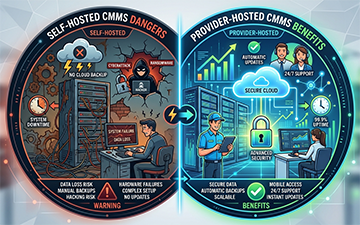 Choosing between a provider-hosted and a self-hosted platform defines the resilience of your entire facility. This guide explores how your CMMS hosting decision dictates your ability to recover from digital disasters and hardware failures. Organizations must weigh the control of an on-site server against the high-level security protocols of a modern cloud provider. Ask yourself: Could your maintenance data survive a ransomware attack?
The Digital Fortress: Why Maintenance Data is a Prime Target
In the modern industrial landscape, hackers no longer just target credit card numbers; they target uptime. If a maintenance department loses its records, the factory floor grinds to a halt because safety protocols, calibration schedules, and parts inventories vanish. A CMMS acts as the vault for this vital information, making its accessibility a matter of operational life or death. When an organization hosts its own data, it assumes the full burden of defending that vault against global threats.
Many facilities believe their internal network remains safe because it sits behind a local firewall. However, the "Security by Obscurity" mindset often fails when a single employee clicks a malicious link. Once ransomware enters a local network, it hunts for database files—specifically those tied to operational software like a CMMS. If the server lacks sophisticated, air-gapped backups, the company faces a choice between paying a ransom or losing years of asset history.
A provider-hosted CMMS changes this dynamic by moving the target. Reputable SaaS providers utilize Tier 3 or Tier 4 data centers with dedicated security teams that monitor threats 24/7. These entities invest millions into defensive infrastructure that the average manufacturing plant simply cannot justify. By offloading the hosting, a maintenance manager ensures that even if the local plant network suffers an attack, the maintenance records remain isolated and accessible via a separate encrypted connection.
The Illusion of Control in Self-Hosted Environments
Self-hosting appeals to organizations that demand absolute authority over their digital environment. These companies often operate in highly regulated industries, such as aerospace or defense, where data cannot leave the physical premises. On paper, this provides total control. In practice, this control creates a massive responsibility that many IT departments struggle to meet.
Maintaining a self-hosted CMMS requires constant vigilance. IT staff must manually apply security patches, manage SQL database permissions, and ensure the hardware remains cool and powered. If a server room air conditioner fails over a weekend, the hardware might fry, taking the maintenance schedules with it. The benefit of a CMMS lies in its ability to predict failures, but it cannot predict its own hardware demise if the local environment isn't perfect.
Furthermore, the "control" of self-hosting often limits the maintenance team's mobility. Technicians frequently find themselves tethered to desktop computers because the internal server doesn't allow external mobile access without complex VPNs. When a technician cannot update a work order at the moment of repair, data accuracy drops. A CMMS loses its value when the information inside it reflects what happened four hours ago rather than what is happening now.
Accelerate your maintenance results
Pick the next step that fits you best: start your free trial or see MAPCON live with our team.
Disaster Recovery: The Core CMMS Benefit
The true value of a CMMS appears during a crisis. Imagine a catastrophic fire or a flood that destroys the local server room. For a self-hosted organization, this might mean the permanent loss of all preventative maintenance records, warranty information, and safety compliance logs. Without these records, proving regulatory compliance becomes impossible, and restarting the plant takes weeks instead of days.
Provider-hosted solutions offer "point-in-time" recovery. Because the data resides in a redundant cloud environment, the provider clones the information across multiple geographic locations. If one data center goes dark, another picks up the slack. A maintenance manager can walk into a local library or use a mobile hotspot to see exactly which machines need attention, regardless of the status of the local plant's physical infrastructure.
This level of resilience protects the company's "Information Gain." Over years of operation, a CMMS builds a library of failure codes and repair procedures. This tribal knowledge, once digitized, becomes the company's most valuable intellectual property. Protecting it in a cloud environment ensures that the "brain" of the maintenance department stays alive even if the "body" of the plant faces a physical or digital setback.
The Cost of the "Free" Internal Server
Decision-makers often choose self-hosting to avoid recurring subscription fees. They view the internal server as a "free" resource since the building already exists and the IT team already receives a salary. This perspective ignores the "Hidden IT Tax." Every hour an internal IT specialist spends troubleshooting a CMMS database is an hour they aren't improving the company's core technology.
A provider-hosted model clarifies the cost. The subscription covers the hardware, the electricity, the security experts, and the automated backups. It transforms a capital expense into an operating expense. Most importantly, it guarantees uptime through a Service Level Agreement (SLA). If a self-hosted server goes down, the maintenance manager has no recourse but to wait for the local IT team to find the time to fix it.
When the CMMS lives in the cloud, the provider handles the "behind the scenes" drudgery. This allows the maintenance team to focus on the actual benefits of the system: reducing spare parts inventory, extending asset life, and ensuring technician safety. The software exists to serve the maintenance department, not to create a new set of tasks for the IT department.
Bridging the Gap with Mobile Access
Modern maintenance happens at the machine, not in an office. A provider-hosted CMMS naturally supports mobile connectivity, allowing technicians to use tablets or smartphones to scan QR codes on equipment. This immediate data entry ensures the CMMS captures the reality of the plant floor. Self-hosted systems often struggle with this because opening a local server to the internet creates significant security risks.
If a technician has to walk 15 minutes back to a terminal to close a work order, they will likely wait until the end of the shift. By then, they have forgotten the specific details—the exact bolt size used or the subtle vibration noticed in a bearing. The cloud-hosted CMMS removes this friction. It brings the power of the database directly to the technician's pocket, ensuring that the data integrity remains high.
High-quality data is the primary driver of CMMS ROI. If the data is incomplete or late, the system cannot accurately predict when a motor will fail. By choosing a hosting method that encourages real-time use, the organization maximizes the return on its software investment. The ease of access provided by SaaS models usually outweighs the perceived benefits of keeping a server in a closet on-site.
Maintenance software that delivers real value
MAPCON helps maintenance teams stay ahead of work orders, support better decisions, and reduce downtime.
Balancing Privacy and Accessibility
The final hurdle in the hosting debate involves data privacy. Some organizations fear that hosting data with a provider means they no longer "own" their information. However, standard SaaS contracts explicitly state that the client retains full ownership of all data. The provider simply acts as the custodian.
The risk of a data breach is a valid concern, but it must be viewed in context. Is a local server with an aging firewall more secure than a data center protected by biometric scanners and military-grade encryption? For 99% of businesses, the provider's environment is vastly more secure. The CMMS provider's reputation depends entirely on their ability to keep client data safe; if they fail, their business vanishes.
Choosing the right hosting partner involves vetting their security certifications, such as SOC 2. These audits provide third-party verification that the provider follows industry-best practices for data protection. When these safeguards exist, the maintenance team can sleep soundly, knowing their work history and future schedules are protected by professionals.
Securing the Future of Facility Maintenance
The decision between provider-hosted and self-hosted CMMS platforms ultimately dictates how quickly a facility recovers from the unexpected. While self-hosting offers a sense of physical proximity, it often introduces vulnerabilities through neglected updates and limited accessibility. The modern industrial environment demands a level of cyber-resilience that few internal IT teams can maintain alongside their daily duties. Transitioning to a provider-hosted model ensures that maintenance professionals focus on their primary objective: keeping the plant running. By placing data in a secure, redundant cloud environment, organizations protect their long-term operational intelligence against the growing threat of digital disruption.
FAQs
What is the main difference between SaaS and self-hosted CMMS?
SaaS is hosted on the provider's servers and accessed via the internet, while self-hosting requires you to install the software on your own local servers.
Can a CMMS help during a ransomware attack?
A provider-hosted CMMS keeps your maintenance data isolated from your local network, allowing you to access repair records even if your plant's internal systems are locked.
Is my data safe in a cloud-hosted CMMS?
Most providers use enterprise-level data centers with 24/7 monitoring and advanced encryption that far exceeds the security of a typical local server.
Does MAPCON offer both hosting options for their CMMS?
Yes, MAPCON provides both SaaS cloud hosting and on-premise self-hosted solutions to meet different corporate security requirements.
How does a CMMS benefit a mobile workforce?
A cloud-based CMMS allows technicians to access work orders and manuals on mobile devices from anywhere in the facility without needing a VPN.
What happens to my data if the CMMS server fails?
With a provider-hosted system, redundant backups ensure your data is restored almost instantly, whereas a self-hosted failure may result in permanent data loss without a manual backup.
MAPCON | 800-922-4336
Try Our CMMS Software Today!
MAPCON CMMS software empowers you to plan and execute PM tasks flawlessly, thanks to its wealth of features and customizable options. Want to see it for yourself? Click the button below to get your FREE 30-day trial of MAPCON!